
Delta put basic fares on sale in every cabin on 8 July 2026, including a Basic Business fare, for travel from September, with no advance seat assignment and no lounge access. Southwest spent 2025 introducing bag fees and a basic fare to a customer base that had never paid either. Over the same stretch Frontier rebuilt its menu into Economy, Premium and Business bundles, Spirit scrapped one of its four new tiers and renamed the rest ten months after launch, and Ryanair shut down its Prime membership after eight months because members claimed more in discounts than they paid in fees.
There is no contradiction here. Bundling and unbundling are the same decision, taken by different airlines about different products.
Every airline needs both. Bundling and a la carte are two settings of the same function, and the right setting changes by product, by segment and by market. Two things decide it: what the extra costs the airline to deliver, and whether the people who want it also want the item sitting next to it.
This piece works through both, then covers where basic economy and branded fares belong, what dynamic bundling can actually do today, how to price a bundle so it earns well, and how to test packaging without giving away yield.
What is the difference between bundled and a la carte ancillaries?
A la carte means every extra carries its own price and is bought on its own: one price for a checked bag, another for a seat assignment, another for fast track. Bundling means two or more of those extras are sold together for a single price, usually below the sum of the parts.
Airlines use four shapes.
Almost every airline bundle in the market is a mixed bundle, and a la carte is still the largest single slice of global ancillary revenue.
IdeaWorksCompany put the worldwide total at an estimated USD 157 billion for 2025 and a la carte sales at USD 21.21 per passenger, set against IATA's estimated average one-way base fare of USD 166.38. The single-item menu is not about to get phased out any time soon. The question is which items should stay on it.
Important considerations in bundling
Put several extras behind one price and something useful happens to the spread of what people will pay for them.
Yannis Bakos and Erik Brynjolfsson worked this out for information goods: bundle a collection of products together and the standard deviation of what buyers will pay, measured per product, comes out lower than it is for the same products sold one at a time. The bigger the bundle, the more of the population sits near the middle of the range rather than at either edge, and the more the seller earns per product.
For valuations that move independently of each other, that spread narrows with the square root of the number of items, so four extras behind one price halve it. A single price then fits far more of the people looking at it than four separate prices could.
Put simply: people disagree wildly about what any one extra is worth. One traveller will pay well for a seat and nothing for Wi-Fi, and the next is the other way round. Put the two behind a single price and those disagreements cancel each other out, so most people end up valuing the pair at roughly the same amount. When almost everyone agrees what something is worth, one price can suit almost everyone.
This result comes with two limits.
Limit one: what the extra costs to deliver
All of that assumes the extras are close to free to supply. Once a product costs real money to deliver, there comes a point where selling it on its own earns more than putting it in a bundle, and that point moves with the number of items in the bundle.
Bakos and Brynjolfsson worked it out for the simple case where willingness to pay is spread evenly: a bundle of two stops paying once delivering an item costs about 14% of the most anyone would pay for it, and a very large bundle holds out until around 41%. Cost is what breaks the argument, and it breaks small bundles first.
Sort an airline catalogue on that basis and it splits cleanly. Seat assignment, priority boarding, fast track, early check-in and Wi-Fi on an aircraft that already carries the hardware cost the airline almost nothing per sale. They bundle well. A checked bag carries fuel burn, handling and ground time. A meal has a real unit cost. A lounge pass has a seat and a catering cost. Extra legroom occupies a row the airline could have sold on its own. Those four resist bundling, and giving them away inside a package is how a bundle turns into a discount.
Limit two: whether the same people want both items
Bundling pays when the customers who value one product highly are not the customers who value the next one highly. Spread the valuations across the population and one price catches both groups.
Airline segments do not always work that way. A Monday-morning business traveller wants flexibility, a front seat, fast track and a lounge, and wants all of them at once. Their valuations are positively correlated, which means a discounted bundle of the four hands money back to the segment least in need of a discount. This is an argument for pricing a premium bundle close to the sum of its parts, or for leaving those products a la carte and letting the traveller assemble their own.
Families are the opposite case. Seats together and a checked bag are worth a lot; change flexibility is worth almost nothing on a booking made nine months ahead for a school holiday.
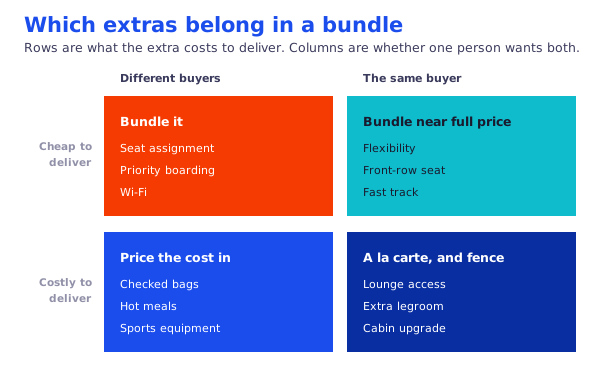
Where two segments genuinely value the same product differently, no bundle averages that difference away. Bakos and Brynjolfsson are explicit about it: when valuations track an underlying customer type, aggregation does not remove the heterogeneity, whatever the bundle size. Separating those segments is a fencing job. It starts with behavioural segmentation rather than cabin class, and it is what fare families exist to do. Different task from bundling, different tools.
When bundling beats a la carte, and when it does not
The clearest measurement comes from a 2023 study by Kevin Wang, Michael Wittman and Thomas Fiig in the Journal of Revenue and Pricing Management, which built airline offers using a Markov chain choice model and compared the result against straightforward a la carte pricing.
Mixed bundling alone lifted revenue per customer by 13.8%. Segmenting the prices took it to 16.4%. Choosing which offers to display rather than showing the whole catalogue took the total to 20.7%, from USD 14.69 per customer to USD 17.73.
The model was never instructed to bundle. Discounted packages emerged from the optimisation, because that is what maximises revenue when valuations vary and some offers are irrelevant to the person looking at them.
Bundling earns its place when the extras cost little to supply, when a product sells poorly on its own and needs a carrier, when the traveller is facing more separate decisions in the airline booking engine than they will patiently work through, or when the base fare has been stripped so far back that the bundle is the only sensible upsell path.
A la carte holds up better when the item has real unit cost, when willingness to pay for it is high and concentrated in one segment, when a large share of travellers already buy it at full price, and when the component is included by regulation anyway.
What it looks like when the arithmetic is wrong
Ryanair sold 55,000 Prime memberships and collected EUR 4.4 million in subscription revenue. Members took EUR 6 million in fare discounts. The airline closed the scheme to new sign-ups on 28 November 2025, eight months after launch, at a net cost of EUR 1.6 million, with chief marketing officer Dara Brady confirming that members claimed more than the scheme brought in. The discount had been set against list prices rather than against the revenue those customers would have generated anyway.
Southwest ran both directions in a single year and got a split result. Bag fee revenue came in ahead of the airline's own expectations. The new basic fare cut unit revenue by around half a percentage point in the second quarter of 2025, and the airline forecast a full point of impact in the third, after conversion dropped and the carrier had to rework its booking flow and marketing to recover it. Southwest still closed 2025 with USD 441 million in net income and guided first-quarter 2026 unit revenue up at least 9.5%. Same catalogue, same twelve months, and the outcome turned on which end of the range was being changed.
Spirit put Go, Go Savvy, Go Comfy and Go Big on sale on 16 August 2024. On 24 June 2025 it dropped Go Savvy altogether and renamed the survivors Value, Premium Economy and Spirit First, citing clarity. Ten months is a short life for a fare brand. A bundle a traveller has to decode is a bundle they will not buy.
Where basic economy and branded fares fit
Basic economy is a fence. Its job is to stop travellers who would have paid more from buying down, and to give the fare above it something to be measured against. Airlines are not trying to sell large volumes of it. They are trying to make the next fare up look reasonable, which is a pricing function rather than a product one.
Delta moved that logic to the front of the aircraft in 2026. Basic fares went on sale in every cabin on 8 July, and Basic Business, for travel from September, drops advance seat assignment, reduces mileage earning, limits checked bags, removes lounge access, rules out upgrades and same-day standby, and reinstates change fees. Lounge access is grandfathered until 18 January 2027. Chief commercial officer Joe Esposito described it as giving customers more ways to choose the Delta experience that fits their trip. Commercially it is the same buy-down barrier, moved twenty rows forward.
Branded fares are close to universal, and what is universal is the static version of them. ATPCO says its branded fares product is used by more than 237 airline partners covering 99.97% of available seat kilometres, which is about as close to full coverage as any airline standard gets. Those tiers are built and filed ahead of the sale. Pricing them that way is a solved problem, and it sits in the mature column of the maturity model further down this piece. Making the same tiers respond to who is asking sits in the emerging and unsolved columns, which is a fair measure of how much of this is still ahead of the industry rather than behind it.
How those tiers are named, compared and presented is a craft of its own. We have written about that side separately in our piece on tailoring the user experience for fare families.
How does dynamic bundling work?
Dynamic bundling is the assembly and pricing of a package at the moment a customer asks for it, based on who is asking and the context of the request, rather than from a package filed weeks in advance. Lufthansa Group's contribution to IATA's dynamic offers work defines it as offers created dynamically based on who is asking and in which context, and its authors noted at the time that static bundling and unbundling had already been running for fifteen years, which puts it closer to twenty now.
Three capabilities have to be in place.
An offer engine capable of real-time offer construction, rather than a fare filing plus a fixed extras page bolted to the end of the booking flow. A price signal for each product in each context, which means elasticity and willingness-to-pay models rather than one list price per route. And a channel that can carry an offer nobody filed, which in practice means the direct channel first and NDC-enabled agency traffic second.
The most cited assessment of how far this has actually got is a practice article on dynamic pricing of airline offers by Thomas Fiig, Remy Le Guen and Mathilde Gauchet of Amadeus, published in the Journal of Revenue and Pricing Management and hosted by IATA.
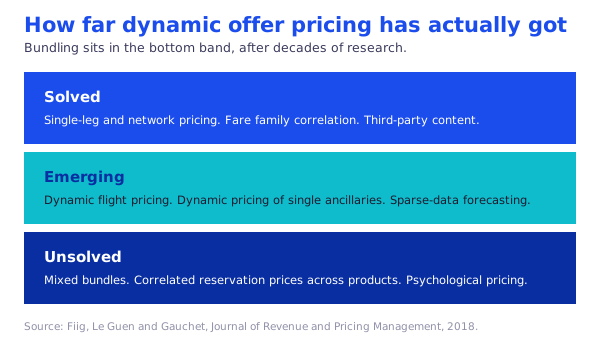
It sorts the problems into three buckets. Single-leg optimisation, network pricing and fare family correlation are mature and solved. Dynamic flight pricing, forecasting on sparse data and dynamic pricing of individual ancillaries are emergent, meaning the methods exist and the implementations are early. Mixed bundles, correlated reservation prices across products and psychological pricing effects sit in the unsolved column after decades of research.
That was written in 2018, and no published assessment since has moved mixed bundles out of it. The subject of this article is, formally, an open problem.
Which is why the state of the art looks so modest up close. Finnair's first live dynamic bundle, launched in September 2025 on Amadeus Nevio through its offers and orders platform, pairs a seat assignment with Wi-Fi, in a limited set of European markets, on flights where full internet access is sold as an extra. Meals, priority services, carry-on baggage and lounge access are queued behind it, in a roadmap rather than in production. Chief digital officer Antti Kleemola's line is that dynamic product bundling gives customers more control and choice. Finnair was also the first airline to create a native order on Amadeus technology, so this is the leading edge rather than a laggard's first attempt.
Composing offers at request time is a platform problem before it is a pricing problem. Triplake holds the catalogue in the Ancillaries Marketplace, including third-party products, assembles and presents the offer through Shop and Fly, and reads what shoppers actually do with it through SkyMetrix Live. A single nudge test run through SkyMetrix Live moved cart revenue by 1.96%.
How should an airline price a bundle?
Six rules cover most of it.
1. Price against incremental margin
The easy method is to total the list prices of the extras, take 20% off and call it a bundle. That sets the discount against revenue the airline was already collecting. Start from what each product actually contributes instead.
2. Make the discount beat what it cannibalises
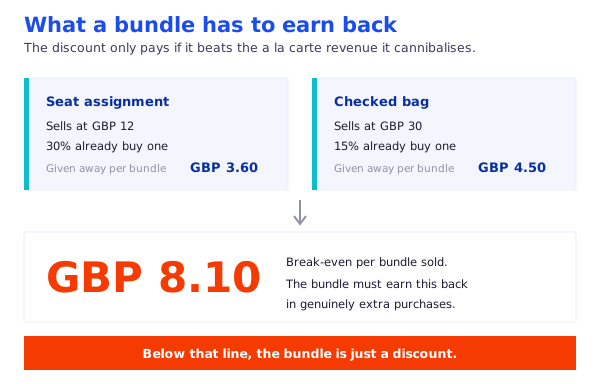
Work the number before the bundle goes live. Say a seat assignment sells at GBP 12 and 30% of passengers on the route already buy one. Including that seat gives away GBP 3.60 of expected revenue for every bundle sold, before the bundle has earned anything. Add a bag at GBP 30 with a 15% standalone attach rate and that is another GBP 4.50. The bundle has to recover GBP 8.10 per sale in genuinely incremental purchases just to break even. Price the discount below that line and the bundle is a price cut wearing a product name.
3. Size the first step deliberately
The first step decides the mix more than the top price does. When Cranky Flier sampled Spirit's new ladder on LAX departures at launch, the move from the base fare to Go Savvy ran roughly USD 40 to 60, the next step to Go Comfy USD 60 to 75, and the jump to Go Big far larger and scaled by distance. That shape puts the smallest decision first and the largest one last, which is a choice about where the volume should land. Set the first step without deciding that on purpose and the mix decides itself.
4. Leave one thing outside the top tier
A bundle containing everything has nowhere to send the customer next. Holding back one desirable item preserves a sale later, at check-in or in the airline mobile app, when the traveller is thinking about the trip rather than the total.
5. Name the bundle after the trip
Diggintravel ran an A/B test on a car hire funnel that copied the airline branded fare pattern: two named options, Budget and Relax, on the search results page, instead of excess cover offered as an add-on two pages later. Conversion fell 1%. Average order value rose 14%, per-session value rose 13%, and uptake of the excess cover rose 35%. Names did the work a feature list could not.
6. Treat regulation as a pricing input
The EU adopted its revised air passenger rights regulation in July 2026, after a political agreement on 15 June. It guarantees a free personal item of 40 by 30 by 15 centimetres, or one that fits under the seat in front, and requires carriers to display fares inclusive of a hand baggage allowance by default.
Widely reported as free cabin bags, it is not that: airlines can still sell a fare without one, and the text sets no dimensions or weight for that bag. The rules apply around a year after publication in the Official Journal, so during 2027. For carriers whose entry-level bundle is built on cabin bag access, the display rule changes what the traveller compares before the fare is even chosen, which is worth modelling before the bundles are rebuilt.
How do you test packaging without eroding yield?
Oliver Ranson sets out the requirements in Airline Revenue Economics: testing pricing properly needs random traffic splitting, behavioural tracking through the booking sequence and abandonment analysis at each step. His example of an airline without them is British Airways, which in response to a subject access request could not show what he had searched for, what seats he preferred or what bags he had bought.
The best-documented airline example is Navitaire's ancillary price optimisation work, written up in the same Amadeus practice article, and its design is deliberately unremarkable. A bag price tested at three points, 70, 100 and 130 in the paper's own units, with 8% of traffic in the test cell and 92% left alone. The middle price produced the highest expected revenue at a 3.7% conversion rate. A decision tree then segmented the result by point of sale and party size, and the segmented model returned 12.4% more revenue than the best single static price.
Five things keep a packaging test from quietly costing money.
Measure revenue per offer shown
Attach rate is the wrong target. Include a product in a bundle and its attach rate rises by construction, whatever the bundle does to the money. Revenue per offer shown moves only when the packaging has actually worked.
Keep a permanent holdout group
Without one there is no baseline once the whole estate has moved, and no way to separate what the bundle did from what the quarter did.
Track each component's standalone revenue
Read it before and after. A bundle that lifts total ancillary revenue while quietly killing seat sales has not done what the dashboard says it has.
Set a floor and a cap before you start
A floor price per component, a cap on the total bundle discount, and an agreement in advance about which result switches the test off.
Do not move the fare in the same test
If the fare and the packaging change together the result is unreadable, and unreadable results are how bad packaging survives for years.
Conclusion: packaging is a control, not a policy
Every airline in this article sells more or less the same catalogue. What separates them is whether a product can move between the a la carte menu, a bundle and a fare tier depending on who is asking and where, and whether anyone can tell afterwards what the move did. That is a Modern Airline Retailing readiness question before it is a pricing one. Ryanair's Prime trial shows what the second half costs when it is missing: the scheme ran for eight months before the numbers were totted up, and by then it was EUR 1.6 million down.
This flexibility is a property of the platform underneath. A filed fare structure with a fixed extras page settles the packaging before the shopping request arrives, so nothing in the offer can respond to who is asking. Triplake is built the other way round, so the offer is composed at the request and measured on the way out. Airlines including KM Malta, Oman Air and Air Mauritius run their direct channel on it.
Talk to us about what your catalogue would earn if the packaging changed by segment rather than by quarter.
Frequently asked questions
What is the difference between bundled and a la carte pricing for airlines?
A la carte pricing gives every extra its own price and sells each one separately, such as a bag fee at checkout. Bundled pricing sells two or more extras together for a single price, usually below the sum of the parts. Most airlines run both at once, which is called mixed bundling.
Is bundling better than a la carte for ancillary revenue?
It depends on the product. A 2023 study in the Journal of Revenue and Pricing Management found mixed bundling lifted revenue per customer by 13.8% over a la carte pricing, rising to 20.7% with segmentation and offer selection. Bundling works best for extras that cost the airline almost nothing to deliver. Items with real unit cost, such as checked bags and meals, usually earn more sold separately.
What is dynamic bundling?
Dynamic bundling is assembling and pricing a package at the moment a customer asks, based on who is asking and the context, rather than from a package filed in advance. It needs an offer engine that composes products at request time, a willingness-to-pay signal per product, and a channel that can carry an unfiled offer. The most cited maturity assessment, an Amadeus practice article hosted by IATA, still lists mixed bundle pricing as an unsolved problem, and live examples remain narrow.
What is the difference between a branded fare and a bundle?
A branded fare is a bundle attached to the fare and sold in the fare display, so the traveller compares tiers before choosing a flight. A bundle in the wider sense can be offered anywhere, including after booking or at check-in, and does not have to be tied to a fare product.
Is basic economy a bundle?
No. Basic economy is a fence, built to stop travellers who would have paid more from buying down and to give the fare above it a reference point. Airlines do not aim to sell large volumes of it.
How big should the discount on an airline bundle be?
Large enough to be visible and smaller than the revenue the bundle cannibalises. Calculate the standalone attach rate for each included component, multiply by its price, and treat that total as the break-even before the bundle earns anything incremental.
Can bundling reduce ancillary revenue?
Yes. Bundling gives away items that a share of travellers were already buying at full price, and if the incremental purchases do not cover that, total ancillary revenue falls. Ryanair's Prime membership cost the airline a net EUR 1.6 million over eight months for exactly that reason.


