
Picture the familiar airline booking flow.
A customer searches. A list of flights appears. They pick one, add a bag, maybe choose a seat, then move to payment. Job done.
For years, that model was good enough. The booking engine was treated as a transaction layer, a place to convert demand into tickets as efficiently as possible.
But airline economics and customer behaviour have moved on.
Today, the booking engine is no longer just where a flight gets purchased. It is where value is explained, confidence is built, ancillaries are merchandised, and the wider journey starts to take shape. In other words, it is no longer just a booking tool. It is the airline’s most important retail channel.
The industry data makes that hard to ignore. According to IATA, 71% of passengers now book online or via mobile app, and 53% prefer the airline’s own website or app. That means the digital storefront is now the primary commercial touchpoint for most travellers. The same IATA research also found that 32% want all travel information consolidated in one place before travel. Customers are not just looking to buy a seat. Increasingly, they expect a guided, joined-up experience.
That expectation matters because the revenue opportunity has changed too. IATA forecasts ancillary and other revenues will reach $145 billion in 2026, representing nearly 14% of total airline revenue. When that much value sits beyond the base fare, the booking experience cannot stay narrowly focused on search and payment. It must become a place where the whole journey is merchandised properly.
Why this shift matters now
Many airlines are still trying to retail through interfaces that were fundamentally designed to process transactions. That creates a mismatch.
The commercial strategy says modern retailing. The channel still says ticket vending machine.
This is one reason why airline retail transformation is not just about offer and order architecture in the background. It is also about what the customer actually sees and experiences in the foreground. McKinsey has estimated that airline retailing could unlock around $40 billion in annual value by 2030. That value will not be captured by technical change alone. It depends on how effectively airlines present products, personalise offers and convert intent inside their digital channels.
And those channels are rarely linear anymore. McKinsey also found that 77% of travellers consult multiple channels before booking. They move between devices, revisit options, compare, pause and return. So the booking engine cannot behave like a static checkout. It has to work like a modern retail environment that supports discovery, continuity and relevance throughout the journey.
What a retail channel does differently
A booking tool processes a request. A retail channel helps customers understand what they are buying, why it matters and what else might improve the journey. That is a fundamentally different job.
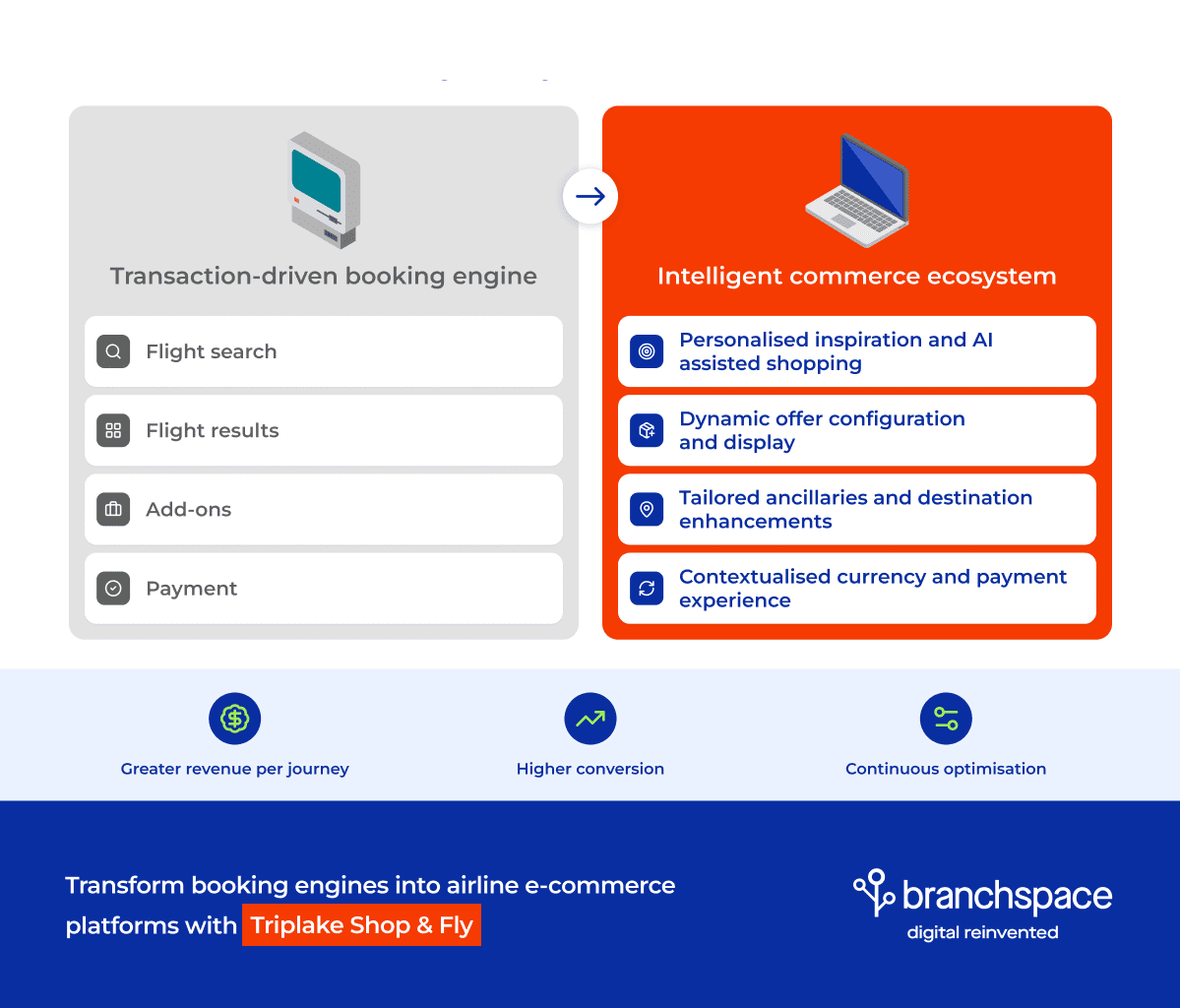
It means showing value, not just inventory. It means positioning ancillaries as meaningful journey enhancements rather than late-stage extras. It means structuring content, bundles, pricing and payment options around customer intent. It also means giving airlines the flexibility to experiment, optimise and adapt continuously.
Related: What Airlines Get Wrong (and Right) About Dynamic Pricing
This is where the conversation becomes more practical. The challenge is not simply to “modernise the booking engine”. It is to turn it into a true airline e-commerce platform.
That is exactly the space Triplake is designed for. As Branchspace’s modular digital retailing platform, it helps airlines build customer-facing channels that are more agile, data-driven and commercially effective. And within that, Triplake Shop & Fly is about moving beyond basic ticketing logic and enabling richer, more contextual shopping across the traveller journey.
The point is not to overload customers with more offers. It is to make the shopping experience more coherent, more relevant and more useful.
The real opportunity sits across the whole journey. This is where airline retail often gets underestimated.
If customers are already using the airline website or app as their main planning and booking environment, then the booking engine is not competing with another airline booking engine alone. It is competing with the best digital commerce experiences customers encounter anywhere else.
That means product presentation matters. Clarity matters. Personalisation matters. Payment experience matters. So does the ability to integrate complementary products and services in a way that feels natural, not bolted on.
We explored a similar point in How travel benefits from headless commerce, where the focus was on how airlines can extend pre-flight revenue opportunities and build more flexible storefronts. It also connects closely with things to consider when moving to Modern Airline Retailing, which makes the case that retail transformation should not just recreate legacy processes with newer technology. And from a customer experience perspective, Rethinking UX for Airline Web Portals in an Intent-driven World reinforces the same idea: airline digital channels work better when they reduce effort and support decisions calmly across the journey.
The takeaway
Airlines do not need their digital channels to behave like better booking forms. They need them to behave like retail channels.
The booking engine is where demand is captured, where ancillaries are contextualised, where value is communicated and where journey-level relevance can either be unlocked or lost. That is why it has become one of the most commercially important pieces of the airline digital landscape.
The airlines that recognise this will move faster towards a more effective model of digital commerce. The ones that do not may continue driving traffic into interfaces that were built to process bookings, but not to retail travel.
And that is the real point.
The future of airline retail will not be won by treating the booking engine as a tool. It will be won by treating it as the storefront.
You might also like:


