
Offer and order management (OOM) is a simpler way for airlines to sell. An offer is what the airline shows you for sale: the flight, the extras and the price, put together in one place. An order is the single record of what you actually bought and how the airline will deliver it. Together they replace the tangle of separate records airlines rely on today, the Passenger Name Record (PNR), the e-ticket and the electronic miscellaneous document (EMD, the record used for ancillaries like bags), with one order and one reference.
This guide is for anyone who wants a clear, jargon-free picture of offers and orders, whether you work on an airline's commercial or digital team or you are simply trying to understand where airline retailing is heading. It explains what offers and orders are, why airlines are moving to them, how they work, how they differ from the older systems, and how a change this big actually happens.
In plain terms: offer and order management swaps a stack of booking references for a single order and gives the airline additional flexibility when it comes to pricing and selling products. It is the foundation that dynamic pricing, personalised offers and richer travel experiences all sit on, and the airlines treating it as a business change, rather than a technology upgrade are the ones pulling ahead.
What is offer and order management?
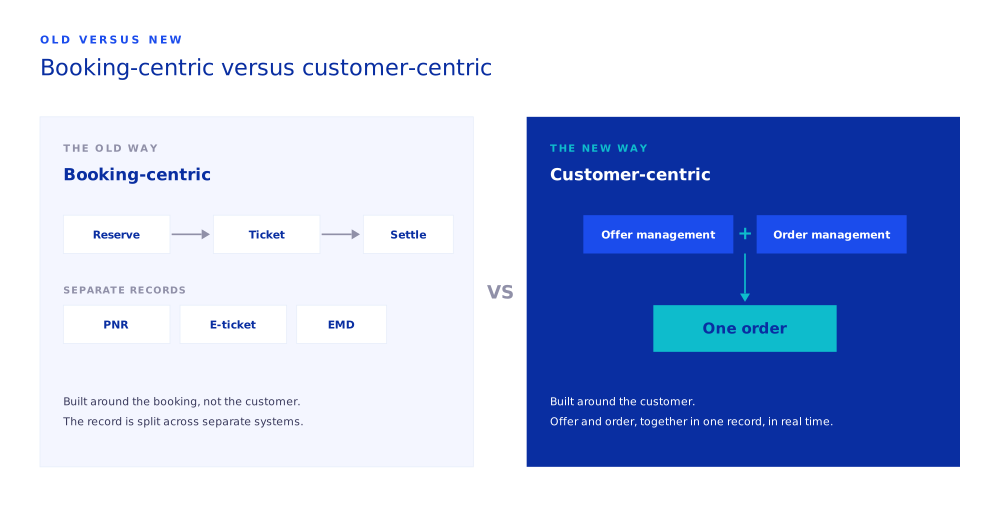
For most of aviation history, airline systems were built around the booking, not the customer. Their job was to take a reservation, print a ticket and settle the transaction. Offer and order management turns that around, so the system is customer centric: the airline puts together and prices a product in real time, then records the sale as one order.
Branchspace's Radu Iliescu describes it as two jobs at once. The first is turning those booking-first systems into retailing systems, so the whole online journey gets better. The second is clearing out decades of built-up complexity, since many full-service airlines still run on business processes that are very old. He explains the full picture in our guide on how to be ready for customer-centric airline distribution.
The model has two halves. Offer management is the part that builds and prices the product you see, sometimes called merchandising, which is simply how products are presented and sold. Order management is the part that records the sale and handles everything after it: taking payment, delivering the trip and keeping the accounts straight. Older systems split these jobs across separate records. Offer and order management brings them together.
What is an offer?
An offer is a ready-to-buy product the airline builds for one specific search: the flights, the extras, the conditions and the price, bundled into a single response. Rather than pulling a price from a fixed, pre-loaded fare table, the airline builds the offer in the moment.
That makes flexible pricing possible. The airline can price based on what a customer is willing to pay, and build bundles responsively instead of relying on fixed fare bundles like Economy Light or Flex.
Pricing can move along a ladder, from continuous pricing, which uses small, smooth price steps, through to pricing each part of a trip on its own and building the bundle up from the parts. We explain that progression, and the older technology that holds it back, in What Airlines Get Wrong (and Right) About Dynamic Pricing, and go deeper in The Four Dimensions of Airline Dynamic Pricing. How data becomes personalised offers is covered in The Airline Personalisation Stack.
The point of the offer is range and relevance. An airline can widen what it sells, including non-air extras that older standards find difficult to handle, and present richer travel experiences priced to customer context, rather than to a fixed table.
What is an order?
An order is the single record of what the customer bought and how the airline will deliver it. It replaces the PNR, the e-ticket and the EMD with one order and one reference. This is the idea behind ONE Order, a standard from the International Air Transport Association (IATA) that folds passenger details, flights, extras, third-party items and payment into one retail-style record.
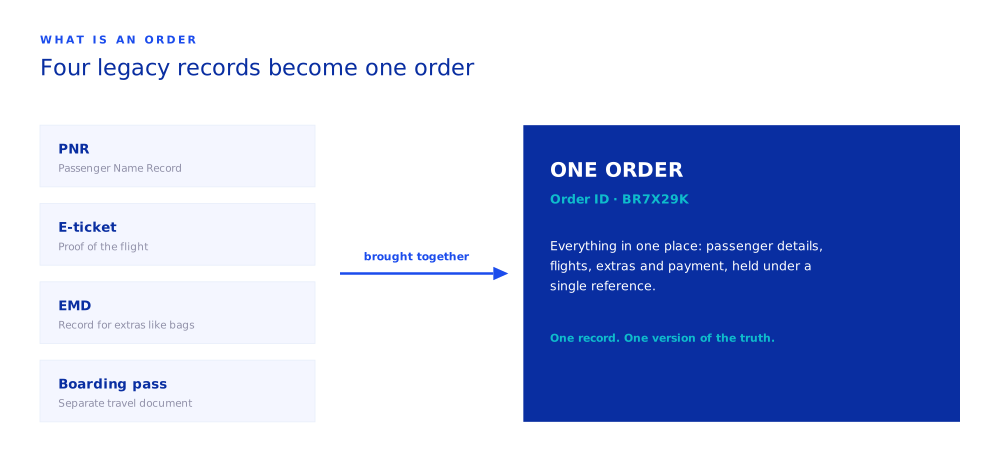
For the airline, that single record becomes the one version of the truth, which removes the complexity that appears when the same booking lives across several records at once. For the passenger, it is simpler: one reference for the whole trip instead of a booking code, a ticket number, one or more extras records and a separate boarding pass. As Radu puts it, most travellers have never understood why one trip needs so many records.
Why are airlines moving to offers and orders?
Two things are pushing airlines to change: the limits of the old records, and the cost of the old way of selling through middlemen.
The PNR isn't exactly retail friendly. Branchspace's Modern Airline Retailing Playbook lists the specific limits in the deep dive section. A single PNR can hold only nine passengers before it becomes a group booking. Every adult on a PNR has to share the same fare, which makes smooth, seat-by-seat pricing awkward. Names are often capped at 64 characters. Infants are treated as an add-on to an adult rather than as passengers in their own right. Booking information ends up scattered across the PNR, the e-ticket and the EMD, which makes mistakes more likely.
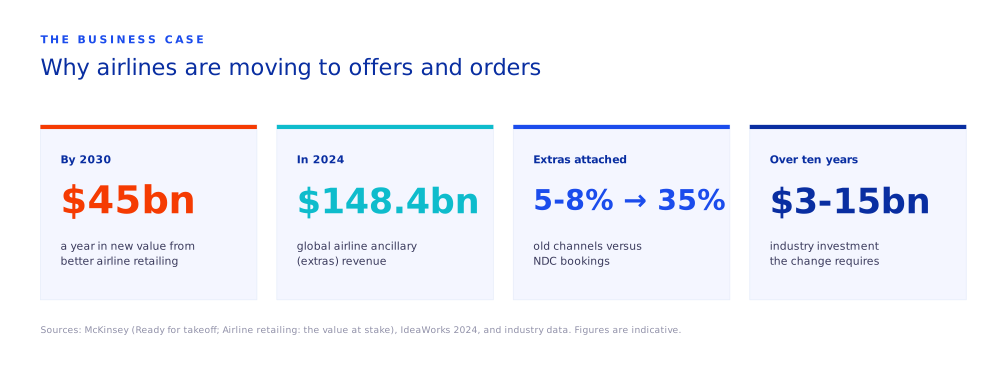
On the selling side, airlines are shifting away from the older channels toward New Distribution Capability (NDC), an industry standard that lets airlines send richer, more complete offers straight to travel agents and customers. The older route runs through the Global Distribution System (GDS), the middlemen that connect travel agents and airlines via EDIFACT (short for Electronic Data Interchange for Administration, Commerce and Transport). The difference shows up in the numbers: on the old channel, only about 5 to 8 percent of bookings pick up ancillaries, while on NDC that reaches roughly 35 percent.
Then there is the money, which is what gets a project approved. McKinsey's latest analysis puts the value of better airline retailing at about USD 45 billion a year by 2030, worth more than 2 to 3 percent of revenue for many airlines.
Extras, known in the industry as ancillaries, already brought in a record USD 148.4 billion in 2024, yet many airlines still cannot package and sell them well across every channel. Around 80% of IATA member airlines now use some form of dynamic pricing, which we cover in The Four Dimensions of Airline Dynamic Pricing.
There is a cost on the other side. McKinsey and IATA estimate the industry will need to invest between USD 3 and 15 billion over ten years, so the business case rests on growing revenue, with cost savings as a bonus. For the longer story of how airline selling got here, read The Long and Winding Journey to Customer-centric Airline Distribution and From the Internet Booking Engine to Digital Experience Platforms.
What is the difference between an order management system (OMS) and a passenger service system (PSS)?
A passenger service system (PSS) is the traditional core of an airline: reservations, seat inventory and ticketing, all built around the PNR. It works, but it ties product design to the system's limits, which is why it is difficult for modern retailing innovation to take hold.
An order management system (OMS) is the new core for the sale itself. It holds the order as one record, separates pricing from the old booking classes, and is built in modular pieces that connect cleanly, so pricing, presentation, delivery and accounting can each improve without replacing everything at once. British Airways calls its programme a second chance to fix a decision the industry got wrong in the 1950s, when airlines first adopted passenger service systems but missed the chance to separate pricing from booking classes. That story is in How British Airways is Leading in Offer & Order Management.
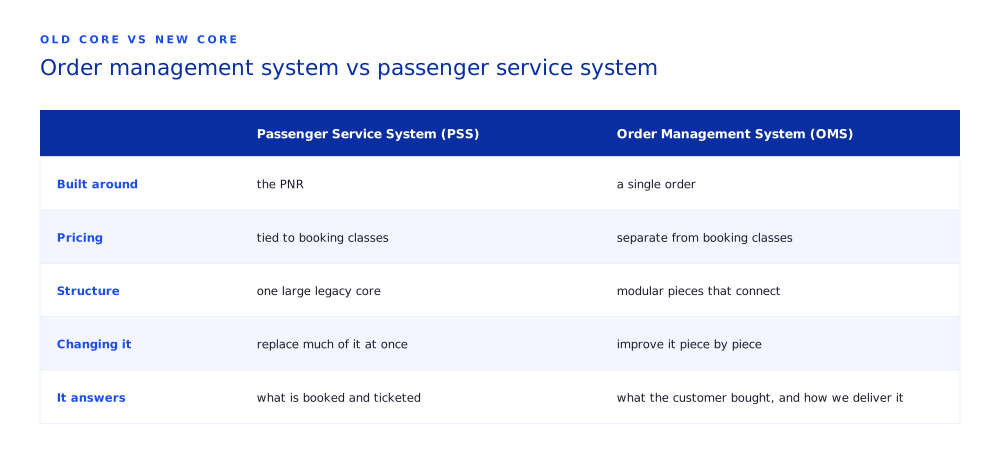
Put simply, the PSS answers "what is booked and ticketed." The OMS answers "what did the customer buy, and how do we deliver it and account for it." For a revenue-management view of the shift, see Revenue Management Insights with Simon Pitt.
How do offers and orders actually work?
Two parts do the work. An offer engine handles the shopping and pricing, building each offer as the customer searches. An order management system records what they buy and then coordinates everything that follows: payment, delivering the trip, and the accounting behind it. An airline can buy both from one supplier or mix and match, picking the best system for each job.
A few ideas make this possible, and none of them need to be technical to grasp. Systems and partners agree on shared industry data standards so they can understand each other, which also makes it easier to swap a supplier later. The parts are kept loosely connected, so the airline can change how it sells without disturbing how it delivers. And the whole thing is modular, so an airline can replace old systems piece by piece instead of in one risky switch-over. We covered that shift in Staying Ahead of the Curve, and a real example of the connecting layer in Designing Virgin Australia's Middleware. The suppliers that plug into this model are listed on our integrations page.
Trips that involve more than one airline change too. The new approach works like an online marketplace. If airline A sells a trip that includes a flight operated by airline B, airline A is the retailer and airline B is the supplier, much as Amazon sells products from other sellers on its own site. Over time, these airline-to-airline connections are expected to move onto NDC and away from the older direct links used today.
How does an airline make the change?
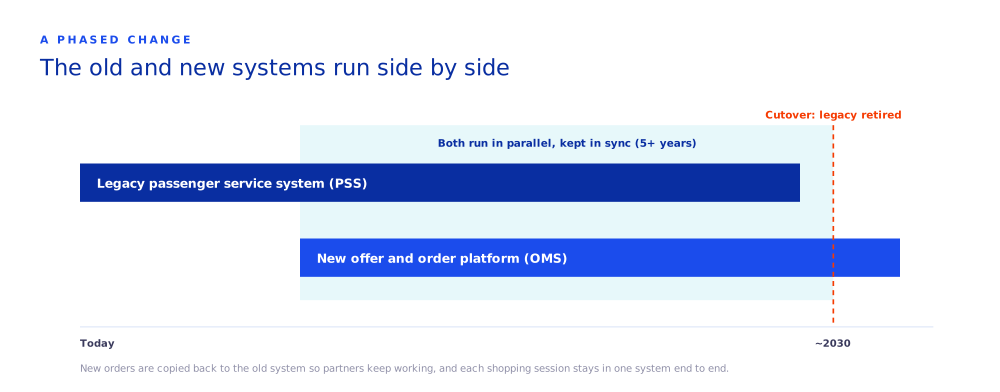
The most important thing to know is that it happens gradually. This is a phased change, and the old and new systems run side by side for years. The new offer and order platform runs alongside the old passenger service system, and the two are kept in step almost in real time, for at least five years on Radu's estimate. New orders are copied back to the old system so existing partners keep working, and a single shopping session stays in one system from start to finish, so deciding what to move first really matters.
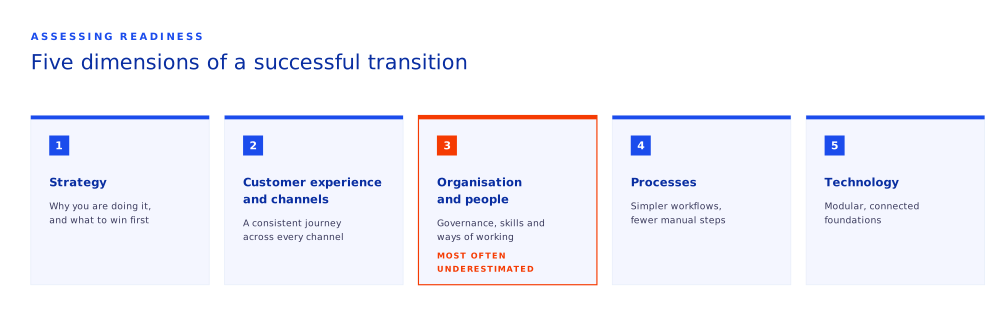
Airlines usually judge how ready they are across five areas: strategy, customer experience and channels, the organisation and its people, day-to-day processes, and technology. The area most often underestimated is the people-and-organisation side, and projects that treat this as a technology upgrade rather than a business change tend to stall. You can check where you stand with the free Modern Airline Retailing Readiness Playbook, and read the strategic overview in Modern airline retailing: finding the balance.
The results are already showing. British Airways is running the biggest technology change in its history, a £750 million programme that Branchspace is part of. Air France-KLM chose Amadeus Nevio as its offer and order supplier, with Branchspace advising through the decision, told in Air France-KLM transforms with Amadeus. On the commercial side, Oman Air grew its direct online share from 18% to 60% in under a year on Branchspace's Triplake platform, with paid seat selection up around 83%, while KM Malta launched its online shop and loyalty scheme and cut payment failures to 0.86%. More sit in our customer stories.
The right move depends on size. A leading airline with the budget to help shape the standards benefits from moving early. For a smaller or mid-sized airline, prepare rather than rush: build the business case, and time a formal supplier search, known as a request for proposal (RFP), for when current system contracts come up for renewal, since that search alone can take months to run well. Branchspace's Transform consulting practice supports airline teams through both the advisory and the build. For how this connects to NDC and AI, see Beyond Buzzwords: NDC, OOM and AI.
Frequently asked questions
Is offer and order management the same as NDC?
No. NDC is the industry standard for how offers and orders move between an airline and its sales channels. Offer and order management is the airline's own way of building offers and holding orders. They are built to work together, and both are covered in Beyond Buzzwords: NDC, OOM and AI.
Is ONE Order the same as an order management system?
ONE Order is IATA's standard for a single order record. An order management system is the software that creates and runs those orders. An airline adopts the ONE Order standard and puts it into practice through an order management system.
Do low-cost carriers already do offers and orders?
Partly. Low-cost carriers manage some of it because they mostly sell simple, single-airline trips, so they can ignore much of the older shared machinery. A full-service airline that connects to many partners faces limits a low-cost carrier does not, which is why the change is harder, and worth more, for those larger airlines.
How long does the change take?
Most airlines are aiming for around 2030, with the old system running alongside the new one for at least five years after go-live. Lufthansa Group has signalled it may move sooner. Fully retiring the old booking, ticketing and middlemen connections may take longer still.
Should a smaller airline start now with offer and order?
Prepare now, build later. Put the business case together and line up a supplier search around your existing contract renewals, and let the systems and standards mature before committing to a large build.
Wrap-up: turning offers and orders into a programme that delivers
The move to offers and orders is the biggest change to how airlines sell in a generation, and the direction is now settled. What is left is doing it: choosing what to change first, keeping the old and new systems in step for years, and bringing the whole organisation along.
This is where Branchspace Transform does its work. Our consulting team checks how ready an airline's digital setup is in a matter of weeks, designs the future offer and order plan and the path to get there, runs the supplier search, compares shopping and pricing engines, and manages the delivery and the change through to go-live.
Many of our consultants come from airlines and from the technology suppliers themselves, and the team sits on IATA's Offer and Order working groups, so the advice reflects where the standards are heading. Because Branchspace also builds the Triplake platform, the guidance is grounded in what works in practice.
The findings in this guide point one way. The value is real and measured, the old limits are specific and fixable, and the risk sits in the planning and the people more than in the technology. An experienced partner is what turns that understanding into a funded, step-by-step programme that delivers early wins instead of stalling.
If you are weighing the move, check where you stand with the free Modern Airline Retailing Readiness Playbook, then talk to the Branchspace Transform team about a path built for your airline.


