
When we started designing Triplake On the Go, we set ourselves a deliberately awkward test:. Imagine a passenger standing in a taxi queue at Muscat with one bar of signal, a delayed connection, and a question they need answered now. Does the app help them, or does it bounce them to a website that was never built for this moment? Many airline apps fail this test. Branchspace built Triplake On the Go to ace it.
The argument is simple. An airline app pays for itself only when it works as a travel companion that helps passengers and sells across the whole journey, rather than a booking tool that just processes a transaction and stops. The rest of this piece traces:
- How we got there with Triplake On the Go
- What passengers now demand
- Why the Companion Model is a commercial winner
The journey of Triplake On the Go
Triplake On the Go was never intended to be just a smaller version of a website on a phone. It was conceived as a dedicated digital touchpoint within the Triplake platform for passengers who prefer engaging with their airline through an app over a browser. It was designed for the reality that they're often genuinely on the move when booking, managing, or preparing for a trip. Futhermore, a phone carries things a desktop cannot, such as a wallet, camera, Face ID, location, and push notifications. We wanted the app to capitalise on all of these, and more.
Triplake On the Go launched in 2023 with our first customer, Oman Air, whose journey to modern retailing we've shared before. Oman Air didn't want a generic airline app. They wanted one that genuinely reflected the people, culture, and hospitality of Oman. That meant spending the time to get the design right and create an experience that felt true to the brand rather than rushing to release another off-the-shelf app. The app went live across the Apple App Store, Google Play and even Huawei AppGallery, because serving Huawei users is the difference between reaching a market and ignoring part of it.
Since launching, the app continuously advances. Oman Air ships new capability roughly every two weeks, meaning the product in a passenger's hand in June has improved from the version used in January. That rhythm is the point. A mobile app is not a project you finish; it is a channel you operate. KM Malta Airlines also adopted the Companion Model as the foundation for its e-Commerce launch, and today the platform powers live booking and servicing journeys for multiple carriers
The results provided the clearest approach validation. Across Oman Air's target markets, the share of bookings completed through the airline's direct channels increased from around 25% to 60% in less than two years. Ancillary revenue per passenger grew at roughly five times its previous rate, and in 2025, Oman Air reported its first positive EBITDA in more than fifteen years. Although not the only reason, a direct channel that sells well is a significant contributor to an airline retaining more of its margins.
What passengers want from an airline mobile app
The bar for an airline app is not set by other airlines, but rather by every other app on a passenger’s phone.
And passengers do not grade on a curve.
Consistency across web and mobile
Retailing flows, product and service offerings, and utility features should be fully available in both channels, with cohesive flows and interface designs. In almost every other industry, the app is a complete alternative to the website. Travellers notice when an airline app hands them off to a browser the moment they move past the home screen. The era of using the app for a couple of things and the desktop site for everything else has closed.
An app that fits into daily life
An airline app should slot into daily habits rather than asking to be a separate chore. Native mobile wallet for speedy payments. A boarding pass and loyalty card that live in Apple Wallet or Google Wallet instead of a screenshot. Face ID to access accounts and legitimise transactions. A preference on how to be contacted, whether via push, SMS, email or WhatsApp. People already manage too many logins. An airline app earns its place by being useful, not by becoming one more source of notifications that people learn to ignore.
A core journey that works every time

This expectation gets the least attention yet matters the most. Travelling is meant to be enjoyable, so it is strange that planning and booking often feels like a chore. Make the main journey easier to complete, easier to trust, and easier to buy from. Because at the end of the day, no volume of features, AI, or gamification will rescue an app that does not perform consistently and securely. Reliability is the feature everything else depends on.
Why a companion beats a booking tool
An app that books flights is a utility. An app that knows the passenger, their miles, their preferences, and their next journey is a direct commercial engine. The first version is a cost centre that processes transactions. The second earns its keep every time the passenger engages with the airline.

A companion behaves differently across the journey. Before the trip, it inspires and helps people plan, with personalised destination ideas, a route map, and deals worth opening. At the point of purchase, a companion makes buying intuitive, carries direct and indirect ancillaries, supports global payment methods and currencies, and redeems loyalty automatically rather than burying it under three other menus.
During travel, it turns anxiety into anticipation, with flight status, a digital boarding pass, interactive seat map, check-in, and live baggage tracking. A companion recognises that loyalty begins the moment a passenger chooses your airline, not after twenty flights. That philosophy underpinned KM Malta Airlines' instant redemption model, allowing members to earn and redeem value from their very first booking.
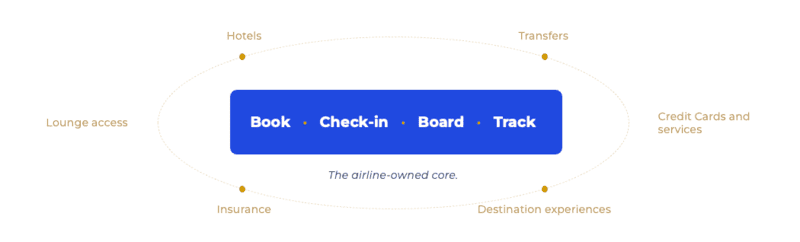
The useful mental model is to build like a super app and behave like an airline. Borrow the ecosystem logic that travellers now expect, hotels, transfers, lounge access, insurance, destination experiences, while empowering airlines with firm control over owned touchpoints, like booking, check-in, boarding, operations tracking. All these elements reaffirm coherent experiences and enable higher margins.
The market forces that make this urgent
Ancillary revenue has moved from a side line to the centre of the airline business. IdeaWorksCompany projected a record $157 billion in global ancillary revenue for 2025, now about 15.7% of total airline revenue, up from 9.1% in 2016. McKinsey & Company estimates that better airline retailing could unlock roughly $40 billion in value by 2030. Much of that value will be won or lost at the customer touchpoint, and increasingly, that touchpoint is a smartphone.
It changes how we should think about the airline app.
Every screen is a place to sell.
Every disruption is a chance to recover the relationship.
Every notification is a moment of contact that either builds trust or erodes it.
Closing the gap between the typical 5% ancillary revenue share and the 10% achieved by leading retailers by 2030 is also a design challenge. It will be solved through better mobile moments, not just smarter fare rules.

In fact, Finnair offered a concrete example of where the industry is going. At FTE EMEA in Dublin this June, Salla Rinta-Kanto, who leads products and retailing development at the airline, described bringing modern retailing on board. Finnair passengers order and pay from their own device through the cabin wi-fi portal, with Apple Pay being the most popular method. It improved the experience for both passengers and crew. The lesson for any airline is that the commercial table now extends into the cabin, running on the device already in the passenger's hand.
We must not forget that pressure is sharpened even more by macro- economics. Airlines run on some of the thinnest margins out of any industry, and geopolitical shocks and operational disruptions affect everyone. When margins are tight, the channel that costs the least and sells the most per passenger stops being a nice-to-have. That channel is direct, and on the routes where people live, it is mobile.
What this means for your airline
If your airline’s app redirects to the website, sells the same ancillaries as a static email, or treats a delay as a notification rather than a recovery moment, it is operating as a utility and leaving revenue on the table. The shift to a Companion Model is a commercial decision before it is a technical one.
Triplake On the Go is the fastest route to making that shift without a multi-year rebuild. It runs on a modern, modular foundation that works with today’s legacy systems, while preparing you for Offer and Order standards. It is designed to start as a focused MVP and evolve as the data proves the business case
Booking, check-in, and servicing are optimised for speed and clarity from day one, and loyalty appears in real journey moments. The marketplace presents passengers airline and third-party products when they’re most likely to buy. Meanwhile, airline teams stay in control through Triplake Control Hub, adjusting retailing rules, running experiments, and harnessing real-time analytics without vendor interference or dependencies.
Discover how Triplake On the Go can help your airline
Further reading: Airline mobile apps in 2026: how to move fast, sell smarter, and keep customers coming back and the free Modern Airline Retailing playbook.


