
A storm closes a hub for six hours. Flights cancel, eight thousand passengers need somewhere to be, and every one of them reaches for their phone at the same time. The airline treats this as a problem to contain: rebook the connections, staff the phone lines, hand out the vouchers, absorb the cost. The clock is running and the only goal is to get everyone moving again with the least damage.
Now look at the same six hours from the passenger's side. This is the most attention they will pay the airline all year. Not during the booking, when they compared four tabs on price. Not at check-in, which they did half-asleep. Right now, stuck in a terminal, refreshing the app every ninety seconds, they are watching what the airline does more closely than at any other point in the trip.
Airlines have spent a decade learning to sell in the calm stretches of a trip, the search, the seat map, the checkout. They have spent almost nothing learning to serve well in the loud one. The message: disruption is a retail moment as much as an operational one.
The hours airlines have decided are pure cost
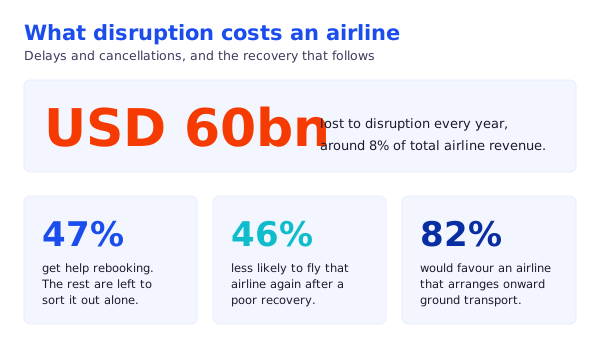
Disruption is expensive, and the industry knows the number. Delays, cancellations and the re-accommodation that follows cost airlines an estimated 8 percent of revenue, around USD 60 billion a year. That figure has trained a whole discipline to think about disruption as loss control. The systems, the teams and the budgets all point one way: reduce the damage, settle the claims, move on.
Loss control is the right instinct for the operation. It is the wrong instinct for the customer. Treating recovery purely as a cost to contain means the airline shows up to its most-watched hour with a script written by the finance and operations departments, and nothing written by the people who sell. The passenger feels it at once, meeting a hold time and a queue where they expected help.
Passengers are never paying closer attention than when things go wrong
Here is what that processing actually delivers. When a journey falls apart, only 47 percent of passengers get any help from the airline arranging an alternative. The other 53 percent sort themselves out or wait for someone else to. More than four in ten UK travellers say a badly handled disruption makes them less likely to book that airline again. Passengers rarely blame the airline for the weather, since a storm is nobody's fault, but what stays with them is the silence and the queue that follow.
That is a retail failure dressed up as an operational one. The airline has the customer's full attention, a clear need, and a phone in their hand already open to the app, and it responds with a call-centre hold time. Compare that with how the same airline behaves when it wants to sell a seat upgrade: personalised, instant, one tap. The capability exists. It has simply never been pointed at the recovery.
Why the old systems cannot sell when it’s needed
The reason is the same reason airlines struggled with airline merchandising for years. The technology underneaths hold a booking, it’s not meant serve a customer in real time. Re-accommodation on a legacy stack means finding new space across separate reservation records, reissuing tickets, and reconciling the extras that were attached to the original flight and now hang loose. It is manual, slow and blind to what the passenger might actually want next.
An offer and order platform changes the ground this stands on. When the sale lives as a single order rather than a PNR, an e-ticket, the airline can rebuild the trip in one place and see everything the passenger holds. Recovery stops being a scramble across systems and becomes a transaction the airline can actually run: here is your new flight, here is the seat you paid for carried across, here is a lounge pass while you wait.
The same architecture that lets an airline sell well in the booking flow is what lets it serve well when the flow breaks. You cannot bolt good disruption handling onto a system that isn't meant to retail. This is why modern airline retailing and disruption are the same project, not two.
What retailing the disruption actually looks like
Start with the obvious: let people help themselves. A passenger who can rebook in three taps, from the app, without joining a queue, is a passenger the airline has just saved a call-centre cost on and impressed at the same time.
Self-service rebooking is the rare move that lowers cost and lifts satisfaction together, and it only works when the airline can present live alternatives against a single order. Branchspace builds this into On The Go, the mobile layer that carries real-time notifications and self-servicing, so the traveller acts on the disruption instead of waiting on it.
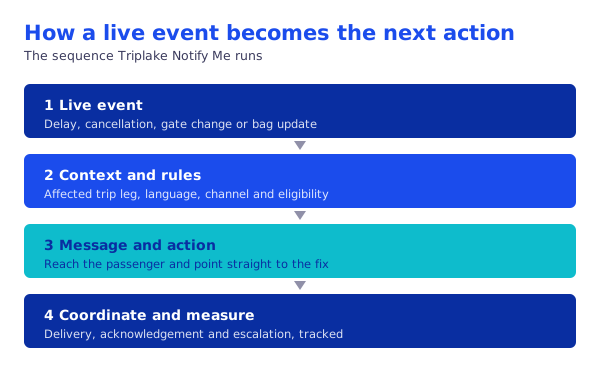
Then get ahead of the passenger. Notify Me is the layer that turns a live journey event into coordinated communication: it identifies who is affected, works out what they need next, and reaches them on the right channel before they have finished refreshing the departure board. A message that says "your connection is gone, here are your options" and points straight to the rebooking flow beats an apology sent an hour later. It can carry a relevant service in the same breath, because Notify Me is built to trigger contextual service and revenue as well as warnings.
The retail part sits inside that recovery. A six-hour delay is a genuine need for food, a lounge, a place to rest, ground transport, sometimes a hotel. Offered clumsily, those are vouchers grudgingly handed over. Offered well, they are relevant products at the point the customer wants them, and 82 percent of travellers say they would favour an airline that arranges onward ground transport when a flight falls through. Done properly, that is service the passenger is grateful for and revenue the airline earns by solving a real problem, the same way Triplake Shop & Fly handles servicing and extras across the rest of the trip.
What the airlines getting this right do differently
The carriers getting this right have stopped drawing a line between the sale and the service. They hold the trip as one order from booking to arrival, so when weather closes a hub they can rebook a passenger, carry their paid extras across, and offer them what they need for the next six hours, all in the same place and mostly without a human in the loop. They come out of the disruption with the customer's goodwill intact and a little more revenue than they went in with, while their rivals are still counting the cost of the vouchers.
Disruption will always cost airlines money. The question is whether it also costs them the customer. Treating recovery as a retail moment, on a platform built to sell and serve from a single order, is how an airline turns its worst day into the one that earns the most trust.
That is the work of Branchspace Transform: checking how ready an airline's digital setup is, designing the offer and order plan that makes this kind of recovery possible, and delivering it through to go-live. If you want to see where your own airline stands, start with the free Modern Airline Retailing Readiness Playbook, then talk to the Branchspace Transform team.


