
Although the aviation industry is accountable for only 2% of all human-induced CO2 emissions, its share is both rapidly growing beyond expectation and directly dangerous on a higher level of the atmosphere. The civil response that birthed the “flygskam” movement represents a growing discomfort with the current situation and must be addressed.
Creating a win-win
Today, travellers can feasibly counteract their emissions by paying a “carbon offset”. Several airlines around the world have already reconnected with their eco-conscious customers by providing customers with: estimations of the CO2 footprint for a booked flight; educational materials covering the airline’s environmental projects; and the opportunity to contribute to airline offsetting initiatives. While implementation and design vary airline to airline, the core elements remain.
When defining a customer interaction for collecting a carbon-offset contribution, an airline should consider utilising the following:
- A calculator for CO2-emissions based on the route, miles travelled, number of passengers, the occupancy rate of the aircraft, the type of the aircraft, and other similar parameters
- A pricing tool that converts CO2-emissions into a monetary amount that will reduce or compensate emissions elsewhere in the world by the same amount of CO2-emission
- An educational portal that examines the airline’s carbon-offsetting projects
- And, like always, a fluid UI and a seamless user experience
Compensation experience outside the booking experience
Sustainability endeavours undertaken by an airline must become part of its brand image. Additionally, nominating select causes – just as Qantas has with their Future Planet initiative – provides a direct avenue for customer engagement. Accompanied by a high-level description of the airline’s environmental initiatives, showcasing a host of environmental initiatives allows travellers the flexibility to support their preferred cause.

Qantas Future Planet
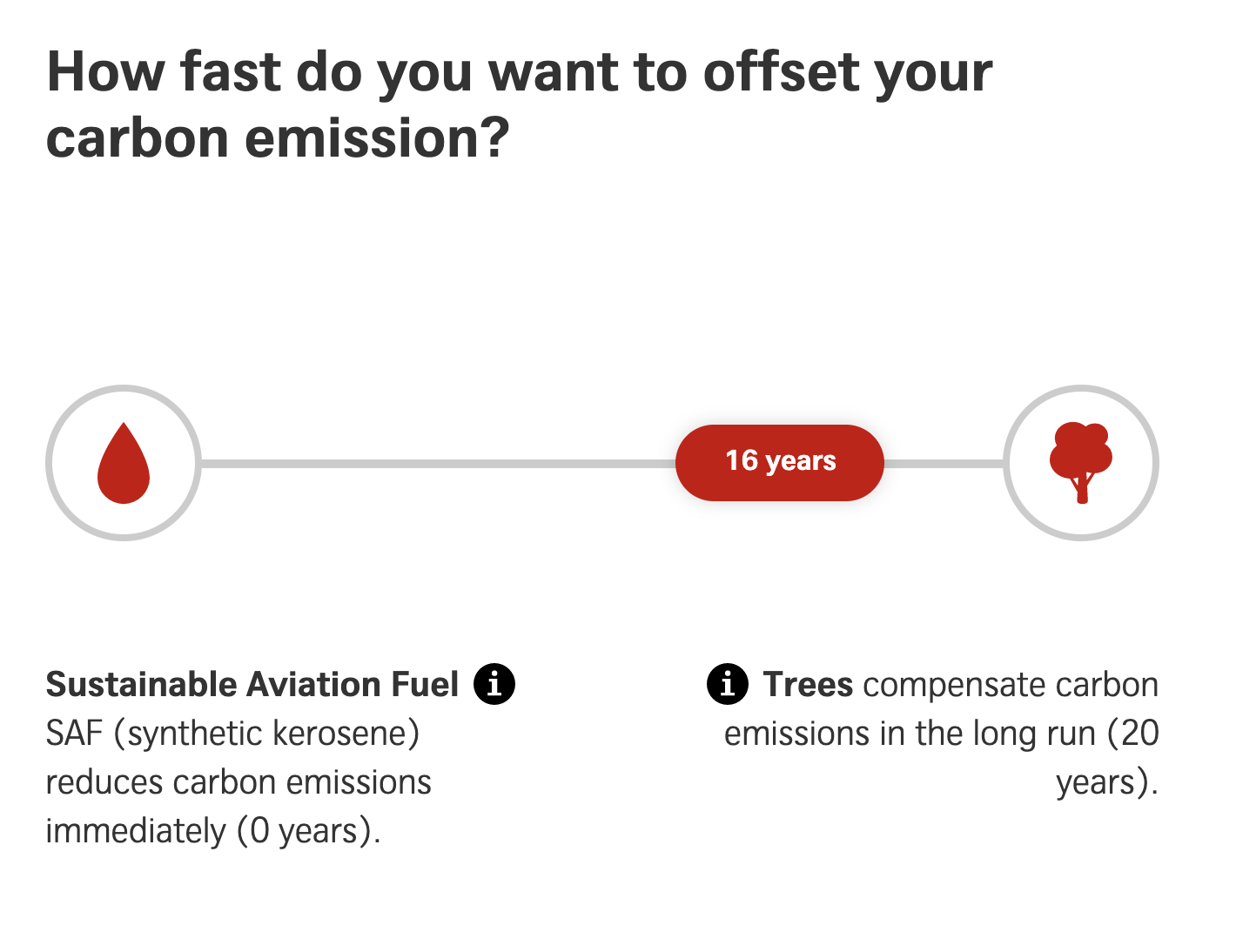
However, as the Qantas experience is hosted outside of the booking flow, a few aspects are misleading. For example, estimating the carbon footprint would be based on pre-calculated data: parameters such as actual miles flown, the occupancy rate of the flight, and aircraft type are not taken into account.
Similarly, Lufthansa Group created Compensaid, a stand-alone CO2 compensation platform. Compensaid allows travellers to choose between contribution to LHG’s Sustainable Aviation Fuel (SAF) and Reforestation. Additionally, unlike Qantas’s program, Compensaid is referenced in SWISS booking flow (‘Extras’ page). Travellers unaware of the program could still land on a Swiss-labeled Compensaid platform and separately compensate their CO2 footprint. This model provides more transparency for eco-conscious travellers.
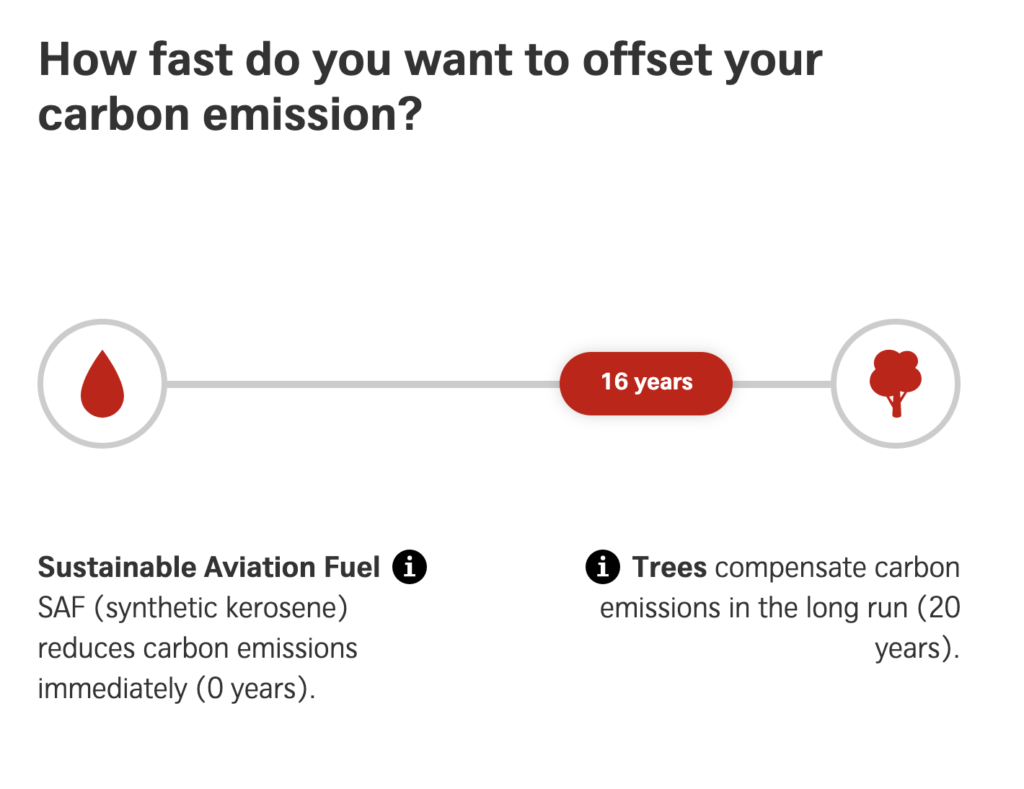
Compensaid Swiss Platform
Contribution as part of the booking flow
KLM’s CO2ZERO is a good example of how an airline could encourage more passengers to contribute, and how to make the contribution amount tailored to the trip. Embedded in the booking flow under “Extras“, the service calculates the amount of CO2 emissions based on received data like aircraft type, distance flown and the historical load factor of a specific flight.
SAS followed a similar approach to KLM and deployed their initiative into the booking flow, but the contributions are directed solely to buying bio-fuel. On the “Extras” page, the customer can add a bio-fuel contribution, where 10 EUR corresponds approximately to 20 minutes of bio-fueled flight time for one traveller on an average SAS flight.

SAS Biofuel Initiative
Takeaway
These examples illustrate that many airlines are responding to the call of eco-conscious customers, and taking measures to make information centring on airline environmental initiatives easily accessible. However, the productisation of “Carbon-Offset” and its standard incorporation into the booking flow is yet to develop and mature across the industry. Furthermore, undertaking these initiatives must be a serious effort on the part of the airline: as shown in recent years, the benefits that “Carbon-Offset” and environmental initiatives deliver to improving customer trust can be quickly overshadowed by the perception that an airline has been dishonest in their efforts.
Inherently, there is great value in incorporating the collection of these CO2 contributions into the booking flow. Configuring new ancillary “Carbon-Offset” products – for which parameters and pricing are defined based on the booking context – allows airlines to address environmental impact at a customer level.
Airlines ought to continue to address the challenge of creating the right experience for travellers who are willing to contribute to the offset of their CO2 footprint. This includes:
- Communication on environmental initiatives: Providing clear, updated descriptions of the airline environmental projects is instrumental in gaining traveller trust.
- Personalisation of CO2 emissions: Incorporating various factors which influence the estimation of CO2 emissions (e.g. actual distance flow, actual load factor) into the Offset product.
- Offsetting alternatives: Enabling travellers to contribute directly to their preferred cause.
- Inclusion in the booking experience: Referencing the CO2 compensation programme or charging as part of the booking flow possibly unlocks a greater number of CO2-offset contributions.
As flygskam becomes the norm for travellers, encouraging a greener brand image and following through with initiatives will become increasingly key to survival.
Follow us on Linkedin for more updates and insights.


