
For years, airline SEO has been treated as a performance discipline. Rankings, traffic, keywords, visibility. Useful metrics, but increasingly incomplete ones.
Today, that assumption is breaking.
Travellers no longer experience airline websites as static destinations. They arrive through fragmented journeys, AI-mediated discovery, questions rather than queries, and expectations shaped by Amazon, Uber and conversational tools. And in that environment, SEO is more than optimisation. It has become a signal of something deeper.
How well does an airline portal understand intent?
How confidently does it guide decisions?
And how effectively does it turn content into knowledge rather than pages?
To explore this, we analysed the web portals and SEO performance of eight airlines across different regions and sizes. The airlines are anonymised, but the patterns are not. What emerged is a picture of how portal design choices are now shaping SEO outcomes, and why that matters for the future of airline digital strategy.

Why airline SEO can no longer be analysed in isolation
Traditional SEO analysis looks at keywords, rankings and traffic volumes. But that lens assumes linear behaviour. Search, click, convert. That is no longer how travellers behave.
Discovery is now decentralised. Intent is expressed conversationally. And increasingly, decisions are shaped before a traveller ever reaches an airline website.
It reflects how well a portal is structured to be understood, reused and trusted by both humans and machines. Which means airline SEO has become a proxy for portal intelligence.
What the data shows at a high level
Across the airlines analysed, one pattern stands out immediately.
Most airline organic traffic is still overwhelmingly brand-led.
For several carriers, between 85 and 95% of organic visits come from branded or navigational searches. Airline name variants. Logins. Check-in. Manage booking.
This is not inherently bad. It reflects strong brand recognition and loyal customer bases. But it also reveals a limitation. SEO success, in many cases, depends on travellers already knowing the airline. Not on the portal helping travellers decide.
At the same time, almost every airline ranks for a large volume of informational keywords. In many cases, informational queries account for 60 to 70% of ranking terms. Yet these pages rarely drive proportional traffic or value.
This gap between visibility and impact points to something structural. To understand it better, three clear portal archetypes emerged from the analysis.
Archetype one: brand-led, task-optimised portals
This is the most common model. It includes large national carriers, regional European airlines, and several medium-sized African operators.
What the SEO data shows
- Organic traffic is dominated by branded searches
- Top keywords are airline name variants and operational queries
- Non-brand discovery is limited and often incidental
In absolute terms, some of these airlines perform very well. Large carriers in particular benefit from scale, authority and backlink volume.
But the structure of their visibility is revealing. SEO traffic primarily reflects existing intent, not emerging intent.
What the portal design reveals
These portals are built around airline processes:
- Book a flight
- Manage booking
- Check in
- Baggage and policies
The homepage is typically dominated by a booking form. Navigation mirrors internal systems. Content exists largely to explain how the airline works, not to help travellers choose.
From a user perspective, the system expects the traveller to understand it.
From an SEO perspective, this leads to heavy reliance on brand gravity. Travellers search for the airline because they already know they want it.
Why this matters
This model performs well in a transactional world. But it struggles when:
- Travellers ask broader questions
- Discovery happens earlier and elsewhere
- AI tools summarise and recommend before the visit
SEO here is resilient, but not adaptive.
Archetype two: hybrid portals with stronger non-brand discovery
A smaller group of airlines show a different profile.
These tend to be carriers operating in tourism-driven markets or island contexts, where destination storytelling is unavoidable.
What the SEO data shows
- A significantly higher share of non-branded traffic
- Strong visibility for destination-led and experience-based searches
- Informational intent keywords that actually drive traffic
In some cases, over 90 percent of organic traffic is non-branded. That is a striking contrast to the brand-heavy norm.
What the portal design reveals
These portals invest in content that behaves like knowledge:
- Destination hubs
- Editorial or magazine sections
- Cultural, experiential and practical travel content
- Product explainers that go beyond fares
Importantly, this content is indexable, modular and reusable. It creates multiple entry points into the portal that do not rely on brand recognition.
While booking remains central, it is not the only narrative.
Why this matters
These airlines capture travellers earlier in their journey. They appear in moments of inspiration, comparison and uncertainty. SEO performance here reflects relevance.
And while these portals are not yet fully intent-led, they are structurally closer to it. Content begins to guide, not just inform.
Archetype three: early intent-led experiments
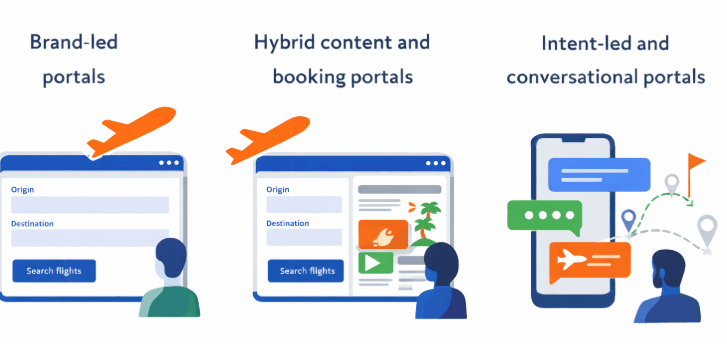
Only one airline in the analysis clearly signals a shift towards assistance and conversation.
It is a regional carrier with modest overall traffic, but an interesting strategic direction.
What the SEO data shows
- Organic traffic remains largely brand-led
- Informational intent is present but under-leveraged
- Discovery potential exists but is not fully realised
What the portal design reveals
This airline explicitly positions itself around help and assistance. Conversational entry points sit alongside the website. Destinations are treated as navigable entities rather than just endpoints.
The intent is clear but he structure is not yet complete. Much of the interaction happens outside the portal, which limits how behavioural insight feeds back into content, navigation and SEO.
This is an early signal of the direction airline portals are moving in. Conversation is only the starting point. The real value comes from learning, and from using that learning to improve discovery, guidance and relevance. Without it, SEO gains will always be constrained.
The hidden SEO problem: informational intent without outcomes
One of the most consistent findings across all airlines is this:
They rank for a lot of informational queries, but those queries rarely lead anywhere meaningful.
FAQs, policies, general explanations and support content dominate keyword lists. Yet they are often disconnected from journeys, offers or decisions. From an SEO perspective, visibility is achieved. From a business perspective, value leaks away.
This happens because:
- Informational pages answer how, not what next
- Content is isolated rather than orchestrated
- Decision confidence is not designed for
In this context, information without guidance is noise. Capturing and converting informational search intent requires a traveller-centric mindset, as explored in Why airline product teams need to think like travellers, where design and value are aligned with real user needs.
Fragmentation as an SEO and experience risk
Another pattern is structural fragmentation. Across multiple airlines, key journeys are split across:
- Main websites
- Third-party booking engines
- External check-in systems
- Separate support portals
This fragmentation has direct SEO consequences.
Authority is diluted and behavioural signals are lost. Navigational searches increase because users are forced to find their way back into the system. More importantly, fragmentation limits AI readiness. Machines struggle to interpret intent across disconnected systems.
What airline SEO performance is really telling us
Taken together, the analysis points to a shift in how SEO should be interpreted.
Strong brand SEO does not mean a portal is future-ready.
Non-brand discovery increasingly correlates with:
- Modular content architecture
- Destination and experience depth
- Clear decision support
- Reduced reliance on navigation
In other words, SEO performance is starting to mirror how well a portal understands travellers, not just how well it ranks pages.
The strategic question for airlines
The future of airline web portals goes beyond better booking engines.
The intent-driven airline web portal must serve as an intelligent interaction layer. A place where intent is understood, uncertainty is reduced, and decisions feel guided rather than forced.
Viewed through that lens, SEO stops being a marketing tactic. Because in an AI-driven world of conversation, intent and decentralised discovery, portals that cannot guide will not just rank lower, they will matter less.
The question is no longer whether airline portals need to change.
It is whether they are ready to be understood.


