
This article comes from Lamiya Merchant, Senior Manager Consultant in Modern Airline Retailing at Branchspace. Before joining us, she spent over fifteen years at Emirates and led AI revenue management adoption for airlines at FLYR, and she draws on that experience here to trace how legacy interlining is giving way to a very different partnership model.
Executive Summary
For decades, interlining has served as the foundation of airline collaboration, enabling carriers to extend network reach, access new markets, and provide customers with broader travel options. However, the industry is undergoing a profound transformation. Traditional interline frameworks, designed around tickets, schedules, and post-travel settlement processes, are increasingly struggling to meet the expectations of modern travelers and the requirements of digital retailing.
As airlines adopt Offer and Order-based retailing models, partnership frameworks must evolve as well. Future collaboration models will require greater transparency, real-time information exchange, enhanced commercial control, and the ability to seamlessly combine air and non-air products within a single customer journey.
This article explores the evolution of airline partnerships, examines the limitations of traditional interline arrangements, and discusses how emerging frameworks such as the Standard Retailer Supplier Interline Agreement (SRSIA) are enabling a new generation of airline retailing partnerships.
1. The Strategic Role of Interlining
Interlining has historically been one of the most important mechanisms for cooperation within the aviation industry. At its core, interlining enables one carrier to sell and service travel products that include transportation provided by another carrier.
Over time, the scope of interlining has expanded well beyond flight segments. Today, partnership arrangements increasingly include ancillary products, multimodal transportation services, and broader travel experiences involving multiple providers.
From a strategic perspective, interlining delivers several benefits:
- Access to markets beyond an airline’s own network.
- Increased customer acquisition opportunities.
- Expanded network relevance for corporate and leisure travelers.
- Enhanced loyalty retention through broader destination coverage.
- Participation in markets where regulatory or ownership restrictions prevent direct operations.
As airline business models have evolved, interlining has become a critical tool for network expansion without requiring significant capital investment in new routes or fleet deployment.
2. Partnership Models in the Legacy Airline Environment
Traditional airline partnerships have largely been built around interline agreements that enable multiple carriers to transport a passenger under a single itinerary and ticket. These arrangements typically include coordinated baggage handling, revenue settlement mechanisms, and customer servicing processes.
Over the years, several partnership structures have emerged :
2.1 Bilateral Interline and Special Prorate Agreements
The most common partnership model has traditionally been the bilateral agreement negotiated directly between two airlines.
These agreements typically define:
- Fare structures and ticketing rules.
- Eligible booking classes.
- Revenue allocation methodologies.
- Baggage transfer procedures.
- Customer service responsibilities.
- Operational and disruption-management processes.
Special Prorate Agreements (SPAs) are frequently used to determine how revenue is distributed when one carrier sells transportation provided by another carrier. These arrangements may establish fixed compensation levels by booking class or utilize predefined proration methodologies.
Where no bilateral SPA exists, airlines may rely on the Multilateral Prorate Agreement (MPA) framework as a default mechanism.
In many cases, carriers also negotiate additional compensation arrangements, including codeshare commissions, particularly where standard interline service charges do not adequately reflect commercial objectives.
2.2 Multilateral Industry Frameworks
To simplify collaboration across a broad range of airlines, carriers often participate in multilateral industry agreements.
IATA provides common standards, legal frameworks, and settlement mechanisms that reduce the complexity associated with establishing individual agreements with numerous partners.
These frameworks have historically played a critical role in enabling global connectivity across diverse airline networks.
2.3 Alliance-Based Cooperation
Global alliances have become another important facilitator of airline partnerships.
Membership in groups such as Star Alliance, SkyTeam, and Oneworld creates an ecosystem in which carriers can more easily establish commercial and operational relationships.
While alliance participation does not automatically create interline agreements, it often provides a governance structure and operational foundation that accelerates partnership development.
2.4 Regional Network Extension Partnerships
Major network carriers frequently collaborate with regional and niche operators to extend their reach into secondary markets.
These partnerships allow larger airlines to provide access to destinations outside their direct network while creating additional traffic opportunities for smaller operators.
2.5 Strategic Partnerships and Joint Ventures
In many cases, interlining forms only one element of a broader commercial relationship.
Joint ventures, coordinated scheduling arrangements, reciprocal loyalty benefits, and joint marketing initiatives often serve as the foundation for deeper strategic cooperation, with interlining acting as an operational enabler within the broader partnership structure.
2.6 Codeshare-Driven Expansion
Many airline relationships evolve progressively.
Partnerships often begin with basic interline arrangements before expanding into codeshare agreements that provide greater commercial integration and network visibility.
Although codesharing is not a prerequisite for interlining, the two models frequently coexist within legacy airline ecosystems.
Codeshare partnerships continue to deliver value by extending network reach and supporting indirect distribution channels. However, from a customer perspective, these arrangements often introduce complexity regarding operating carriers, service ownership, and disruption management.
3. Operational Foundations of Traditional Interlining
Historically, establishing an interline relationship required significant operational and technological alignment between participating airlines.
Core requirements typically included:
- Compatible reservation and ticketing platforms.
- Coordinated baggage handling capabilities.
- Shared booking class structures.
- Revenue accounting and settlement processes.
- Agreed customer servicing procedures.
- Common disruption management protocols.
- Regulatory and compliance alignment.
For many years, these requirements created substantial barriers to partnership expansion, particularly when ancillary products and services were involved.
The underlying technology landscape often made cross-carrier distribution, fulfillment, and settlement highly complex, limiting innovation and slowing the introduction of new customer propositions.
4. Limitations of the Legacy Interline Framework
While traditional interline agreements have successfully enabled airline cooperation for decades, the model was designed for an industry built around tickets, schedules, and post-travel settlement processes. As airlines transition toward modern retailing, many of the assumptions underpinning legacy interlining are becoming increasingly restrictive.
One of the primary challenges is the fragmented nature of customer ownership and data sharing. In a traditional interline environment, each carrier typically has visibility only into the portion of the journey it operates. As a result, no single party possesses a complete view of the customer journey, limiting the ability to proactively manage disruptions or deliver personalized services across partners.
The customer experience is particularly vulnerable during irregular operations. Passengers often face uncertainty regarding which airline is responsible for re-accommodation, compensation, or service recovery. These ambiguities can lead to increased call center volumes, inconsistent communication, and reduced customer satisfaction.
Commercial complexity represents another significant challenge. Airlines frequently rely on multiple overlapping agreements—including interline, codeshare, prorate, involuntary rerouting, e-ticketing, and premium service agreements—to govern a single partnership. This increases administrative overhead and slows the establishment of new commercial relationships.
Ancillary retailing presents an additional limitation. Legacy frameworks were designed primarily for the exchange of flight inventory and fares. As airlines increasingly depend on ancillary revenue streams, existing partnership models struggle to support the distribution, fulfillment, servicing, and settlement of non-flight products across multiple carriers.
Furthermore, settlement processes often occur after travel has been completed, reducing transparency and limiting commercial control. Airlines may have little visibility into the end-to-end economics of a customer transaction until well after the service has been delivered.
Collectively, these challenges highlight a growing disconnect between legacy interline structures and the requirements of modern airline retailing.
5. Emerging Alternatives to Traditional Interlining
Recognizing the limitations of legacy frameworks, airlines and travel providers have begun exploring alternative partnership models that offer greater flexibility and faster market access.
5.1 Non-IATA Partnership Models
A growing number of partnership structures operate outside traditional IATA interline mechanisms. These models seek to simplify connectivity between carriers while leveraging digital technologies and third-party service providers.
Virtual interlining is one of the examples of this type of partnership.
Under this model, itineraries are assembled from flights operated by multiple airlines that may have no commercial relationship with one another. The connection is typically created by an online travel agency (OTA) or digital intermediary rather than by the airlines themselves.
From a customer perspective, virtual interlining offers access to more destinations, increased itinerary flexibility, and often lower fares. By combining independent one-way journeys, intermediaries can create travel options that may not be available through traditional airline partnerships.
However, the model introduces significant operational challenges.
Because participating airlines are often unaware of the customer's complete itinerary, they cannot proactively support the passenger during disruptions. Baggage handling may require passengers to collect and recheck bags at connection points, while schedule changes can create substantial customer service challenges.
In response, many intermediaries have introduced connection guarantees and protection products designed to mitigate these risks.
Despite its limitations, virtual interlining highlights an important market reality: customers value flexibility and comprehensive travel options, even when traditional airline partnerships do not exist.
The future partnership model should therefore seek to combine the flexibility of virtual interlining with the operational reliability and transparency of formal airline cooperation.
One prominent example is Worldwide by easyJet, where the platform is powered by Dohop, which enables easyJet flights to be sold alongside services operated by other airlines and enables this capability for many other carriers. In this model, traditional interline functions such as baggage transfers and disruption support may be coordinated by independent service providers rather than the airlines themselves.
These arrangements demonstrate that customer connectivity can be achieved without the full operational and commercial complexity associated with traditional interline agreements.
5.2 Expanding Beyond Airlines
Partnership ecosystems are also expanding beyond aviation.
Many airlines are actively pursuing relationships with low-cost carriers that do not participate in traditional ticketing frameworks. At the same time, partnerships with rail operators, bus companies, mobility providers, hotels, insurance companies, and other travel-related suppliers are becoming increasingly important.
The objective is no longer simply to connect flights. Instead, airlines are seeking to create end-to-end travel experiences that combine transportation and non-transportation services within a unified customer proposition.
This evolution requires partnership frameworks capable of supporting a much broader range of products, suppliers, and commercial models.
6. The Transition to Offer & Order Retailing
The airline industry is currently undergoing a fundamental shift from a ticket-centric operating model to a retail-centric model built on Offers and Orders.
In this environment, airlines move beyond selling flights and instead become retailers of travel experiences. Products are dynamically assembled, personalized, and delivered based on customer preferences, contextual information, and commercial objectives.
This transition has profound implications for partnerships.
Rather than exchanging fares and inventory through predefined structures, airlines can exchange retail products, ancillary services, and complete travel bundles. Real-time information sharing enables greater transparency and more effective customer servicing throughout the journey.
The Offer & Order model also supports a broader range of partnerships, including:
- Airline-to-airline retailing relationships.
- Intermodal travel partnerships.
- Mobility and hospitality integrations.
- Third-party travel ecosystem participation.
Under this framework, a customer receives a clearer and more consistent experience, while suppliers retain visibility and control over their products and commercial relationships.
The result is a more agile partnership ecosystem capable of supporting modern retailing strategies and rapidly evolving customer expectations.
7. SRSIA: The Foundation for Future Partnerships
To support the transition toward modern airline retailing, IATA has introduced the Standard Retailer Supplier Interline Agreement (SRSIA). SRSIA is defined in the IATA Recommended Practice 1780s that was approved by the PSC at the end of 2021.
SRSIA represents a significant evolution from traditional interline and proration frameworks. Rather than focusing on validating carriers, participating carriers, marketing carriers, or operating carriers, SRSIA adopts concepts familiar to broader retail industries.
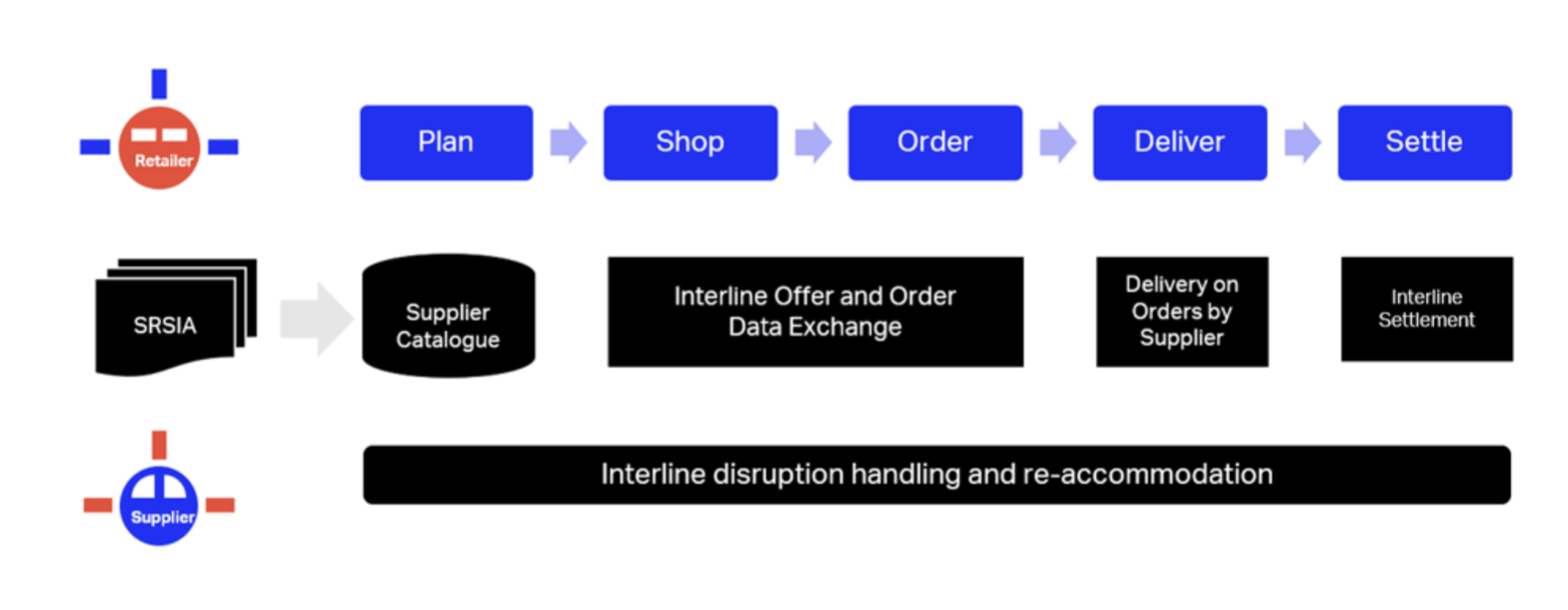
The framework introduces two primary roles:
Retailer
The Retailer owns the customer relationship and is responsible for creating offers, managing orders, and servicing the customer throughout the journey. A Retailer initiates a relationship with a customer at the time of the customer making a shopping request and provides products and services to a customer either directly or by engaging Suppliers. These concepts are more aligned with non-industry specific retail concepts, and better support an open framework where the products and services of many different suppliers can be combined into an offer for a customer
Supplier
The Supplier provides products and services that may be incorporated into the Retailer's offers. Suppliers may include airlines, rail operators, hotels, mobility providers, or other travel-related organizations.
This model creates a clearer division of responsibilities and aligns commercial relationships with how products are actually sold in a retail environment.
A Modular Partnership Framework
Unlike traditional interline agreements, SRSIA uses a modular structure consisting of a foundational agreement supported by optional annexes.
This approach enables partners to formalize different types of relationships without negotiating entirely new contractual frameworks for each scenario.
The benefits include:
- Reduced administrative burden.
- Faster partner onboarding.
- Greater commercial flexibility.
- Improved scalability across multiple supplier types.
- Support for future retailing innovations.
The framework is designed to coexist with existing interline agreements while providing a pathway toward a more modern partnership ecosystem.
8. Strategic Implications and Recommendations
The evolution from traditional interlining to retailer-supplier partnerships represents more than a technology transformation. It reflects a fundamental shift in how airlines collaborate, distribute products, and manage customer relationships.
Airlines should consider several strategic priorities as they prepare for this transition.
Reassess Partnership Portfolios
Existing interline and codeshare relationships should be evaluated against future retailing objectives. Airlines should identify opportunities to simplify overlapping agreements and create more flexible partnership structures.
Invest in Offer & Order Capabilities
Modern partnership models depend on real-time offer creation, order management, servicing, and settlement capabilities. These foundational technologies will become critical enablers of future growth.
Expand Beyond Traditional Airline Ecosystems
The future travel experience will increasingly involve multiple transport and service providers. Airlines should develop partnership strategies that include rail operators, mobility providers, hospitality partners, and ancillary suppliers.
Prioritise Customer Transparency
Future partnerships should be designed around clear ownership of customer interactions, proactive disruption management, and seamless servicing across all suppliers participating in a journey.
Embrace Modular Commercial Frameworks
Frameworks such as SRSIA offer an opportunity to reduce complexity while improving agility. Airlines that adopt standardized, scalable partnership structures will be better positioned to respond to changing market dynamics.
Conclusion
Interlining has enabled global airline connectivity for more than half a century, but the industry is entering a new era. Legacy partnership frameworks, while still valuable, were not designed for a world of dynamic offers, real-time retailing, and ecosystem-based travel experiences.
The emergence of Offer & Order retailing, combined with frameworks such as SRSIA, provides an opportunity to rethink how airlines collaborate. By shifting from carrier-centric agreements to retailer-supplier relationships, airlines can simplify partnership management, improve customer experiences, expand retail opportunities, and create a more flexible foundation for future growth.
The future of airline partnerships is no longer defined solely by network connectivity. It is increasingly defined by the ability to create, combine, and deliver compelling travel experiences across an interconnected ecosystem of suppliers.
How Branchspace can help
Reassessing a partnership portfolio or moving towards and implementing Offer & Order capability is complex and time-consuming for the Airline's Commercial and technology team, in addition to their daily tasks.
Branchspace's Transform consulting has expertise and experience in supporting and assisting multiple, large airlines transition towards offer order. The team of experts across different areas works with airline teams to bridge the gap: assessing digital maturity, designing the target Offer & Order system landscape, and running the RFP process that selects the right technology partner.
Branchspace team members also sit on the IATA working groups shaping the Offer & Order standards this article describes, including SRSIA and provide a head start to airlines and their partners on the OOMS journey.
Airlines thinking of and working on what a retailer-supplier model would mean for their own network, can contact us to start the conversation with the Transform team.


