
Years of competition with the low-cost model have encouraged various cost-reduction and ancillary revenue maximisation practices to become somewhat industry standard, to the customer’s detriment.
Our analysis has identified four complex barriers to creating an engaging and rewarding digital experience (DX):
- Aggressive and irrelevant upselling & cross-selling
- Unclear or misleading flight and ancillary product descriptions
- Inflexible, constraining or pointlessly complicated functional flows
- Frustrating booking management processes
Each of these issues deserves ample consideration – and more time than a single blog post will allow. For that reason, we will begin by looking at how airlines can help their customers begin by examining how removing dark UX patterns and introducing more relevant and considerate sales techniques can improve the travel digital experience.
Dark UX patterns
As an inherently customer-centric speciality, UX design should be all about creating brilliant, seamless user experiences. However, rather than removing obstacles to conversion, some travel retailers rely on dark UX patterns that subtly push the user towards a pre-determined goal. This could entail adding unnecessary ancillary products or upgrades to their shopping basket, unwittingly subscribing to a newsletter, loyalty programme or notifications, or paying with dynamic currency conversion at inflated exchange rates. In the long term, these dark UX patterns risk jeopardising customer trust and alienating users.
An airline’s commercial goals need not be misaligned with prioritising a customer-centric digital experience. Contextualised selling can both maximise revenue and create rewarding, user-friendly booking flows.
Improving DX with contextualised selling
Rather than tricking users into unintended journeys, the principles of persuasive design could prove to be extremely valuable to both the airline and its customers if employed ethically and smartly. By leveraging pre-computed data and personalising the digital user experience, travel providers can improve customer satisfaction and maximise legitimate and relevant product sales – without sending users down the rabbit hole.
There are a few areas where we think an airline can leverage its digital commerce platform and channels to achieve an optimal DX, as shown below.
1. Maximise flight conversion by surfacing flight availability and schedules in the flows as early and intuitively as possible.
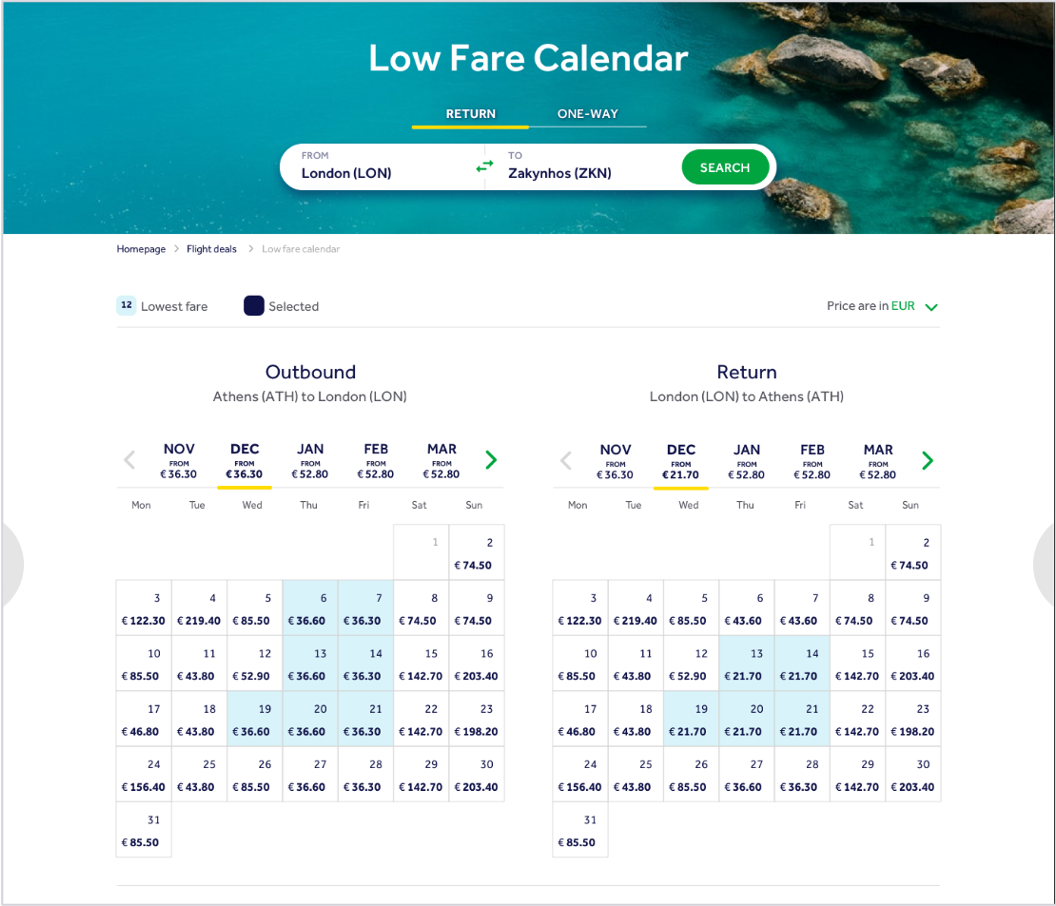
A low fare calendar gives a high-level view of prices
This could mean using pre-computed, wide-range shopping data to:
- provide a high-level indication of flight prices and availability by date in the date picker as part of the flight search
- automatically jump to alternative dates which have availability (in case the user is searching for dates with limited or no availability);
- or provide visual overviews of pricing evolution (e.g. a price histogram for an entire year).
2. Adapt the UX of flight and ancillary products to be specific to the context of each customer and search.
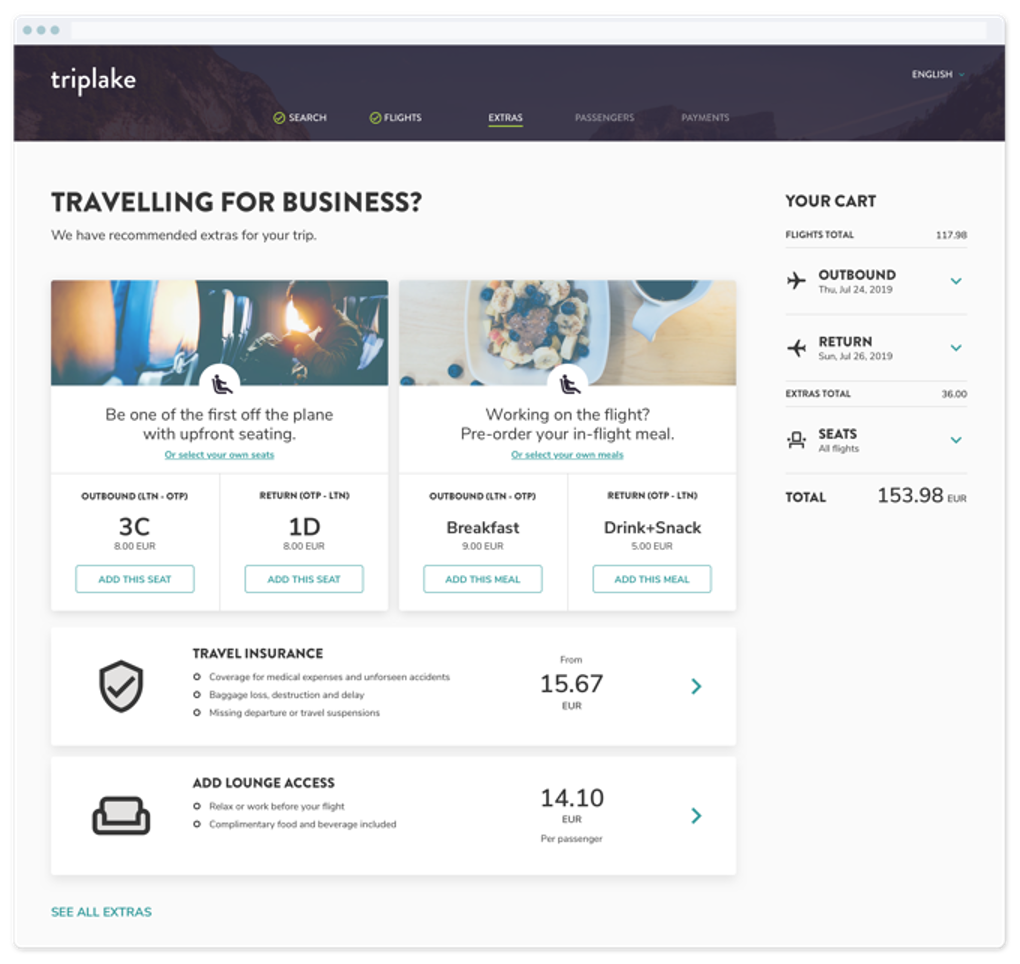
Offers tailored to a business traveller
Capturing important details about the user or trip characteristics is critical to creating relevant, more engaging flows. For example:
- For business travellers, it might be more effective to rely on a screen layout that emphasises flight schedules and maximises the number of flight options displayed; on the other hand, for personal bookings it could be more effective to emphasise price and display the most cost-effective flight options.
- If there are multiple passengers in a search, it would be more effective to facilitate seat selection for all passengers simultaneously and recommend the most relevant seating options based on their context (e.g. a business traveller will likely prefer front of cabin seating while somebody travelling with an infant may prefer seating close to a toilet with a baby-changing table).
In absence of sophisticated machine learning models, using statistical analysis to isolate buyer profiles could help inform a set of manually configured business rules, which in turn allows the airline to filter and sort products of their ancillary offering by gauging the customer’s propensity to buy. Similar propensity-based rules could be used for a form of payment, in conjunction with additional logic for optimising the cost of payment.
3. Ensure that all commercial communications, including newsletters, alerts and notifications, are adapted to the needs and interests of each customer, rather than taking a one-size-fits-all approach.

Allow users to opt-in to pricing alerts
Specific price alerts with clearly defined routes and travel dates, to which the customer deliberately subscribes, can be more effective than mass newsletters or browser notifications which push the same offers to everyone. Specifically, for returning customers, by using statistical models and ML to predict their next destinations, airlines could tailor promotional offers on their homepage and in their push marketing emails and notifications.
Takeaway
While aggressive and irrelevant upselling & cross-selling techniques may have worked in the past, today’s situation shows that they are no longer viable. Rather, as shown above, there are smarter, more sustainable measures that can drive revenues by optimising areas of the digital experience – such as wide-range shopping, contextualised flight and ancillary products offering and more tailored marketing communications.
These techniques are at the same time more ethical, more effective in terms of conversion / attach rates and basket values, and able to boost customer satisfaction, thus creating a longer-term loyalty which can be crucial for the success of an airline in post-pandemic world.
Follow us on Linkedin for more insights into improving your digital experience.


